

Norman Tebbit was the natural heir to Thatcher

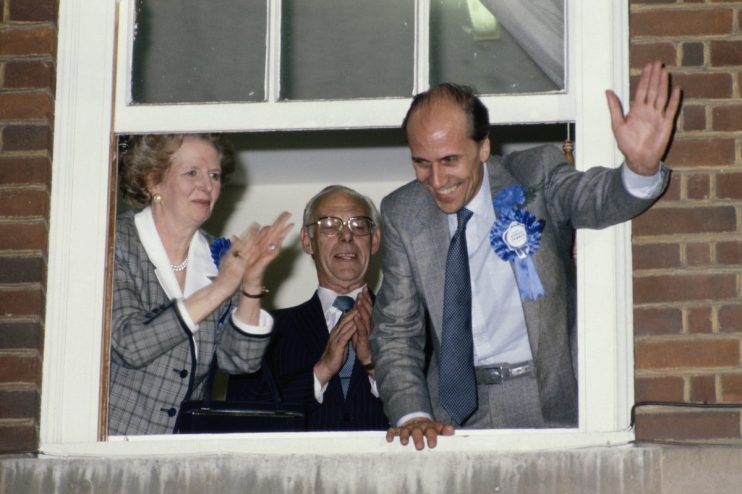
John Redwood shares his reminisces of Norman Tebbit, a giant of Conservative politics
Norman Tebbit was a towering figure in the Thatcher Cabinet. I worked closely with him as Margaret’s chief policy adviser in the middle years of her government. He was often the minister around the Cabinet committee tables who went straight to the heart of the matter under discussion. He sometimes had the sharp turn of phrase to encapsulate the main point or difficulty so well.
He was a loyal supporter of the Prime Minister, sharing an outlook on life with her. He communicated often and well with the wider world and was a fierce exponent of the government’s message. Like Margaret, he had a mission to improve the UK. He spoke the truth as he saw it, and stuck to a strategy designed to bring it about. People knew where they were with Norman, and understood what he thought was right.
Norman came from a less privileged background than the public school men in the Cabinet. A former airline pilot and trade union member of BALPA, he had decided to break closed shops which could harm members. Margaret Thatcher made him employment secretary and he put through the 1982 legislation. The main aim of the Conservative reforms embedded in several pieces of new law was to give more voice and vote to trade union members. Every strike would need a ballot of approval, to avoid trade union bosses calling a strike which the members did not want. Closed shops had to be supported by the majority.
Norman vs the miners
When the coal board got into dispute with the miners, it was Norman who pointed out the key issue for the board was to move coal rather than to mine more. Stockpiles were high and the dispute revolved around attempts to prevent lorries collecting the coal that had already been mined. Norman took a tough line, reinforcing the view that this was a commercial dispute between board and miners in which government should not intervene to find a negotiated settlement.
My first serious exchange with him came at one of the early Cabinet Committee meetings where I briefed the Prime Minister. Not knowing her well enough at that point, I prepared a hard hitting private paper for her on the many failings of the management of British Leyland, why the car industry under public ownership was loss making and declining, and how we needed a major change of policy. I attended the meeting to see how the brief was used, only to be shocked that she read out large chunks of it with obvious pleasure. All the room knew who must have written it, as civil service papers did not usually sound like that. Norman was livid, as he took the whole thing as a personal attack as his industry department was responsible for the policy. I spent time afterwards trying to reassure him I did not intend it as an attack on him, and would be happy to work with him on a policy that could salvage more of our car industry which had been in freefall since the 1970s. I learned to tone down my messages to Margaret as clearly they were getting through.
When Margaret resigned I went with some other friendly MPs to his room and asked him to run for the leadership of the Conservative party. He was to me and others the natural heir to take over
Norman’s success as a Cabinet minister at employment then industry was overwhelmed by the Brighton bomb. He himself was badly injured, but recovered. His wife was permanently disabled, changing their lives forever. It meant he gave up a Cabinet post in 1987 and retired from the Commons in 1992.
When Margaret resigned I went with some other friendly MPs to his room and asked him to run for the leadership of the Conservative party. He was to me and others the natural heir to take over. He told us he could not do that, given the need to look after his wife. It was a sad moment to accept the reality that his life had been changed fundamentally by the terrorist act. It was typical of Norman that he put loyalty and love to his wife before other considerations.
Our country owes Norman Tebbit and his family a debt of gratitude for the service he gave, and for shouldering the burden of injury and disability in his home life as a result of their public lives.
John Redwood is a former secretary of state for wales and was director of Margaret Thatcher’s Number 10 policy unit