Skip to content
City PM
  • Germany
  • France
  • Europe
  • Markets
  • Business
  • Opinion
  • DE
  • Germany
  • France
  • Europe
  • Markets
  • Business
  • Opinion
  • DE
Wednesday 03 June 2015 8:22 pm

Britain’s jobs market has taken off and wages are starting to rise – are young workers benefiting?

By: Express KCS

Add as a preferred source on Google

It is not easy moving from school to the office. It has always been a difficult jump, and in the financial crisis, some found it impossible.
 
Witness the surge in youth unemployment in the financial crisis, soaring from 12 per cent at the start of 2008 to 20.2 per cent in early 2011, for 18- to 24-year olds.
 
For 16 and 17-year olds, the figure peaked at more the 40 per cent. Although the figures include those in full-time education but still seeking part-time work, they illustrate the dire scale of the challenge.
 
The unemployment rate for older groups fell progressively lower, with those aged 50 to 64 years old peaking at 5.2 per cent. The recovery has also apparently favoured the older workers, with 14.3 per cent of 18 to 24-year olds still unemployed, compared with 3.4 per cent of 50- to 64-year olds.
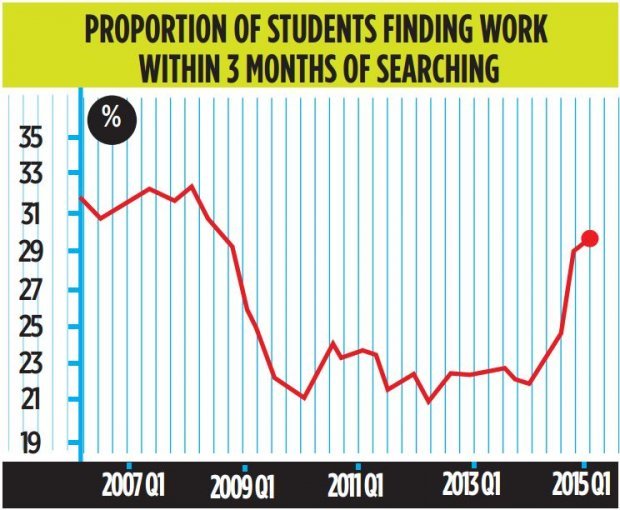


Older workers have more options – those with little chance of getting the job they want are more likely to just retire. Young workers cannot do that.
 
But overall those figures suggest employers in the modern economy value experience and skills very highly.
 
Young workers do not have the experience of the workplace, the knowledge base built up over a long career, or the contacts gained from decades of work.
 
Thankfully, as the economy has  recovered, employers are more confident and so can take a risk hiring an untested worker, and training them up.
 
Furthermore, the collapse in unemployment means there is a much smaller pool of older workers available, pushing them to hire young staff. As that pool of available talent shrinks further, the pressure to pay higher wages to get the workers increases.
 
But what kind of jobs are they? Zero-hours contracts are the scourge of the labour market, at least in popular imagination. Official numbers also provide hints of relief on this score.
 
The proportion of temporary workers who want a permanent job but cannot find one is down from a high of more than 40 per cent to below 35 per cent.
 
And the proportion of part-time workers who cannot find a full-time role has slid to 16.1 per cent.
 
“The labour market recovery has broadened out, you can see it in the relative performance in full-time employment relative to part-time,” said Deloitte’s chief economist Ian Stewart. “So it will be similar in wages for young people as unemployment rates come down. We are going to see sustained growth, which will help lift wages for entry level work.” 
 
[custom id="21"]
 

Share this article

  • Facebook
  • X
  • LinkedIn
  • WhatsApp
  • Email

Similarly tagged content:

Sections

  • Markets & Economics
  • News

Categories

  • Business
  • Economics

Related Topics

  • employment and wages
  • UK jobs

Trending Articles

  • Burnham tax plans spark investor rush to bank capital gains

  • Nothing fails to file accounts months after dissolution threat

  • I’ve taken the best train trips in the world. Here are my 5 favourites

  • Cruyff turn: Starmer allows pubs to stay open for England World Cup game

  • Nottingham Forest owner Marinakis announces £210m stadium plans

More from City PM

  • Jobs crisis: UK unemployment to hit highest level in a decade

    Business
    London office workers collaborating on AI and tech projects, surrounded by computers and digital interfaces in a modern wo...
  • Starmer ally defends minimum wage quango after Sunak calls for it to be axed

    Economics
    Labour's Pat McFadden could oversee small welfare reforms that could make reasonable savings for public finances.
  • Two-tier taxes are not the way to get Britain back to work

    Opinion
    Robert Jenrick speaking at a press conference, addressing current policy issues, wearing a suit and standing behind a podium
  • Making the jump to self-employment could damage your pension savings

    Personal Finance
    In 2022, rolling Tube strikes led to massive queues for crowded buses. (Photo by Chris J Ratcliffe/Getty Images)
  • Nearly half of retail workers considering quitting over mental health

    Retail
    Whitfield will replace outgoing chair Andy Higginson.
  • ‘Under pressure’: Gen Z fail to save as financial responsibilities mount

    Personal Finance
    Young UK graduates from Gen Z celebrating in caps and gowns, representing the future workforce and educational achievements.
  • Job vacancies fall again in unemployment risk 

    Economics
    People waiting outside a job centre, highlighting unemployment issues and job search challenges in the current economy.
  • Britain should look to Japan to manage its ageing population

    Opinion
    Elderly pedestrians crossing a busy street in Tokyo, illustrating Japans ageing population challenge.

City PM — European politics, business and analysis.

Europe

  • Germany
  • France
  • Europe
  • UK & Ireland

Topics

  • Business
  • Markets
  • AI
  • Technology
  • Opinion
  • Energy

More

  • Politics
  • Economics
  • Fintech
  • Legal
  • Sport
  • Life

Company

  • About City PM
  • Editorial Policy
  • Corrections
  • Contact
  • Terms of Use
  • Privacy Policy
  • Cookie Policy
© 2026 City PM · Published by CityPM Media, Bahnhofstrasse 65, 8001 Zürich, Switzerland
About · Editorial Policy · Corrections · Contact · Privacy