
Meet the lawyer that launched Mayer Brown into Space (law)

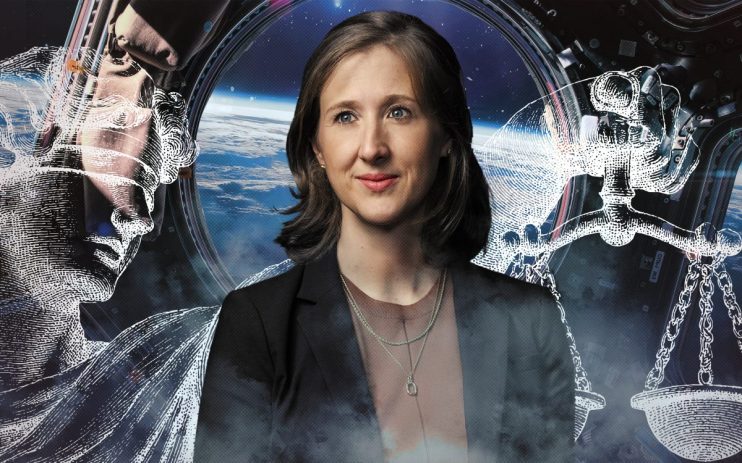
Fifteen years ago, Rachael O’Grady, an arbitration lawyer, had a blown-up satellite operator case land on her desk, a case that would pique her interest and ultimately lead to the creation of a space practice at Mayer Brown.
“Given my international law background, I started thinking about space and how that might interact with international law, and it fueled a professional academic interest in space and satellite activity, space-derived technologies, and how they interacted on an international law level,” O’Grady told City PM.
The law firm was among the first to offer comprehensive legal services in space, including international law, contractual arbitration, and regulatory advice.
While Mayer Brown initially stood alone as a ‘one-stop shop’ for clients, the recent surge in interest in the space sector has brought more firms to the table.
A stellar surge in commercial activity
Despite the origins of space stretching back to the Big Bang roughly 13.8 bn years ago, humanity’s material engagement with space is surprisingly quite recent. It was only 67 years ago that the Soviet Union launched the first artificial Earth-orbiting satellite.
This marked the dawn of a new era in technology.
O’Grady explained that back then it was nations that sent these satellites into space, far out from Earth, in geostationary orbit. “They are far away, or relatively far away; the range that they can beam down on Earth is very large.”
The range of these satellites is large, but as O’Grady explained, they do take longer to launch and are more expensive because they are larger in size and need more fuel.
However, in recent decades rapid technological advancements have fuelled a growing demand for faster satellites to meet increasing needs.
“What’s happened over the last 15 years in technology and science has just exploded, and there are all of these new things happening, one of which is that the profile of satellites has changed,” she explained.
The first satellite launched by a private company was the Malaysian satellite RazakSat, which was launched on 14 July 2009, aboard Elon Musk’s SpaceX Falcon 1 rocket.
Musk’s SpaceX is the company that frequently makes headlines, but there are other private companies already working in this field. There are even other known names, such as Amazon’s Project Kuiper, that are not yet launched to the market.
Due to the explosion of technologies, including the proliferation of AI activity, over the last two decades, a ravenous desire for high-speed data has emerged. Private companies are launching smaller satellites closer to Earth, offering a cheaper and quicker route to placing a satellite in space.
“Instead of only using geostationary orbit, we’re now also using low earth orbit,” O’Grady explained. However, she added, “because it’s much closer, it has a smaller reach.”
As a result of the spread being significantly less than that of traditional satellites, these private companies need to create a “constellation or web” with smaller satellites so they can link up and communicate, achieving the coverage these companies desire.
Orbit overload
However, humanity has a tendency to overuse everything it encounters.
Alongside the surge of satellites entering space, headlines earlier this year highlighted celebrities like Katy Perry being sent into orbit by Amazon as part of their space tourism initiative. Additionally, some companies now offer rose gardens designed for installation in space, while others have created champagne bottles that can be opened in zero gravity.
The major concern for satellite companies going forward is the potential for increased collisions, given the large number of satellites being launched into orbit.
O’Grady explained: “Even a tiny fleck of paint can cause a huge amount of damage because it’s travelling at such high speeds. It was a speck of paint that smashed a window in the International Space Station in 2016.”
She added, “If we never ever launch anything else into space from now, the concentrations of space debris are already so large that they will continue to rise, because they’ll bump and crash into each other.”
What is the law regarding this?
The law in space is currently governed by the Outer Space Treaty (OST), a principle negotiated by the United Nations and signed by over 115 countries. The fundamentals of the law are that nations are responsible for supervising their own governmental and non-governmental (including private) space activities.
However, as space activities become increasingly complex, more scenarios arise that fall outside the current legal framework, necessitating the development of new regulations to address these emerging issues.
Legal limbo
Currently, everything is operating under existing laws, including both international and domestic laws. However, O’Grady has argued that in the next five to ten years, something will happen that falls outside these laws.
If a dispute arises in the future, depending on the parties involved, the situation may become somewhat complicated.
Currently, if it is a state-to-state dispute, the venue for this dispute is the International Court of Justice. O’Grady also noted that states have diplomatic channels to use. While private entities often govern disputes between themselves through contracts, any dispute will either be resolved by the courts of their choice or it will be subject to an arbitration clause.
“It is when you have a private entity against a state that things start to become more challenging,” O’Grady explained.
“If a private company has a dispute against a state that doesn’t fall under an Investment Treaty, and there is no contract, for the likes of a satellite collision, the parties can’t go to the International Court of Justice; there is no way to resolve that dispute by default,” she added.
As there is no existing mechanism to address this problem, O’Grady suggested that “the creation of an International Convention on the Settlement of Outer Space Disputes” is necessary. However, as she pointed out, in this day and age it will be very difficult to get a global consensus on anything substantive.
While the future of space law remains uncertain, one thing is clear: as humanity’s reach into the cosmos continues, the need for adaptive lawyers will only grow.
“Client demand will likely continue to increase as the work in the sector continues to increase and the sector itself is expanding,” O’Grady stated, adding, the practice will continue to grow in response so it can offer the “one stop shop for clients so that they can feel like they are in a safe pair of hands”.