
Labour’s public investment quandary

The government has faced a number of calls to boost the relatively low level of public investment as it seeks to turn the UK into the top-performing economy in the G7.
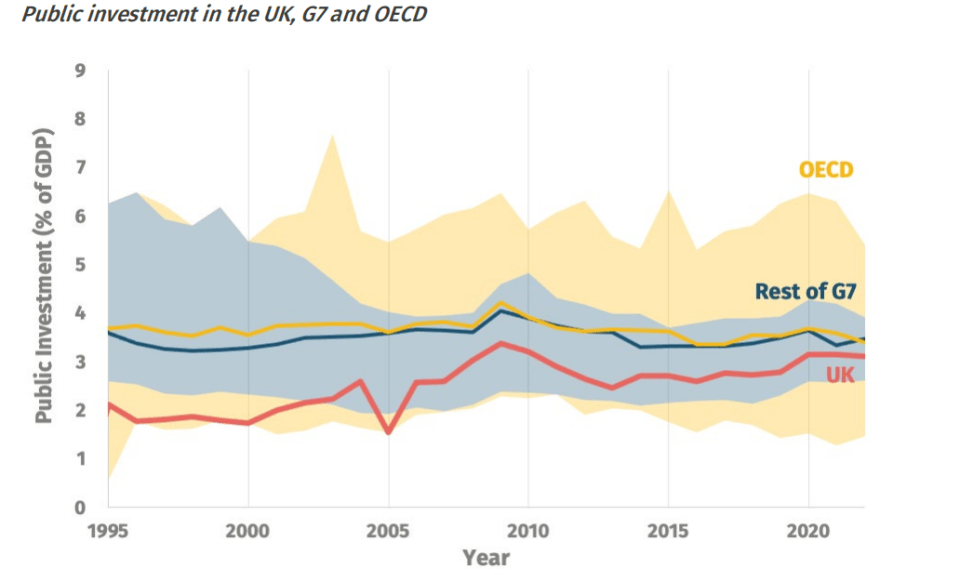
According to the Institute for Public Policy Research (IPPR), public investment as a share of GDP has lagged the G7 average every year since the early 1990s.
Many economists think low levels of investment have contributed to the UK’s sluggish economic performance since the financial crisis, and investment is widely seen as an important lever for improving the UK’s growth rate.
In its manifesto, Labour promised to increase public investment by £4.7bn per year, suggesting that this would “unlock additional private sector investment, create jobs, and provide a return for taxpayers.”
But even with this proposed top-up, public investment is still projected to fall as a share of GDP throughout the parliament.
That’s partly because the previous government froze investment in cash terms over the next five years, amounting to significant real terms cuts, and partly due to the impact of wear and tear on existing assets.
The government’s proposed increase only partially offsets these cuts.
Last week eight eight leading economists, including former Cabinet Secretary Gus O’Donnell and professor Mariana Mazzucato, warned that Labour would be unable to deliver its promised decade of national renewal if it went ahead with these reductions to investment spending.
“The government has inherited spending plans that imply substantial real-term cuts in public investment over the current parliament…To follow through on these plans would be to repeat the mistakes of the past,” they wrote in a letter to the Financial Times.
The economists blamed a fiscal framework which has an “inbuilt bias” against investment.
The current set of fiscal rules require debt to be falling in five years time, which is not long enough for most investment projects to bear fruit.
However, the upfront costs are still included in the forecast, which means Chancellors are incentivised to cut capital spending when finances are tight.
So far, Rachel Reeves has appeared to follow the historic trend. In the immediate spending cuts announced upon the discovery of the £22bn blackhole, Reeves cut funding for some major infrastructure projects.
She scrapped the £1.7bn tunnel under Stonehenge and the A27 Arundel bypass and paused Boris Johnson’s £500m Restoring Your Railway Fund, which sought to restore railway lines shut down during the Beeching cuts in the 1960s.
The decision sparked some alarm among business groups and economists alike for its potential knock-on impact on economic growth and the signal it sent approaching the Budget.
Last week, Andy Burnham, mayor of Manchester, warned the Treasury against making further investment cuts over the weeks and months ahead.
“There are a number of ‘growth tests’ looming – not least on rail infrastructure – and we will find out soon whether the Treasury is able to transform itself into the growth department,” he told the Financial Times.
Business groups also want to see an increase in investment. In a statement accompanying their budget submission, Jonathan Geldart, director general of the Institute of Directors, said the UK needed fiscal rules which “accommodate borrowing for the purposes of investment”.
Interestingly, the Office for Budget Responsibility (OBR), the arbiter of fiscal prudence, set out its own thoughts on public investment at the end of August.
According to its models, a sustained one per cent increase in public investment could “plausibly increase the level of potential output by just under half a percent after five years and around 2.5 per cent in the long run (50 years).”
In other words, public investment should pay for itself more than twice over. Whether or not this convinces the Chancellor is another question.
A Treasury spokesperson said: “The new Chancellor has vowed to lead the most pro-growth Treasury in the country’s history that unlocks wealth and opportunity in every corner of the United Kingdom.
“That work of change has already begun, including the launch of a new national wealth fund to deliver economic growth, unlock investment and make every part of the country better off”.