
Keir Starmer won’t fix the economy

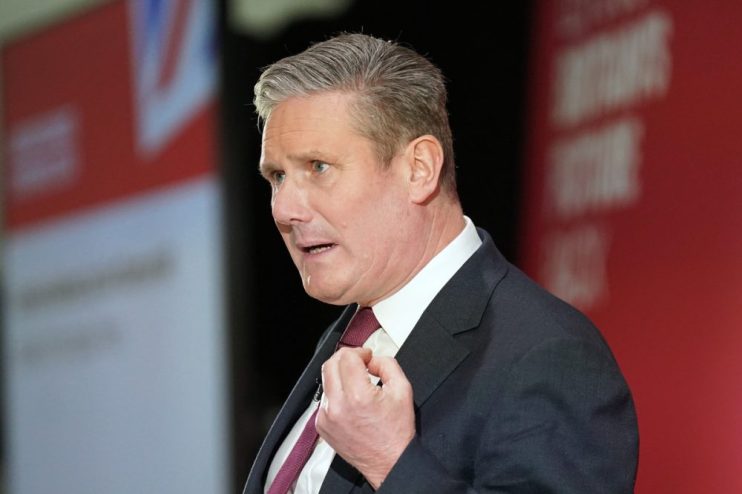
Keir Starmer is driving home the message that “Labour has changed”, but it remains a dirigiste party, believing that the state must play a substantial and active role in the management of the economy, says Eliot Wilson
Parliament will formally be dissolved this week, after Rishi Sunak announced the general election will be held on 4 July. We have been waiting for this campaign for a long time, though the Prime Minister caught Westminster by surprise with his timing, as most had expected the election to come in October or November.
There is a widespread assumption, supported by polling data, that the Labour Party will win a substantial majority and Sir Keir Starmer will become prime minister at the age of 61. Rachel Reeves, an economist who once worked at the Bank of England, is expected to become the first female chancellor of the Exchequer; Jonathan Reynolds, an amiable centrist who spent three years as shadow City minister, is slated to take over the Department for Business and Trade.
In politics, however, there is no such thing as a foregone conclusion. Before you cast your vote, then, what are the major economic and business issues on which Labour’s offering should be examined?
A fundamental part of its prospectus is economic stability. In order to deliver this, Labour has promised to work within current spending plans, ruled out borrowing to fund day-to-day expenditure and will guarantee in law that permanent government tax and spending changes will be based on independent forecasts by an enhanced Office for Budget Responsibility. These strictures are intelligible in political terms, because it is a traditional, if not entirely fair, accusation that Labour governments lose control of public spending. They have, however, restricted Starmer’s and Reeves’s room for manoeuvre, and we have already seen the party shed commitments like its £28bn investment in green industries.
Labour is eager to revitalise the UK’s capital markets. Financing Growth: Labour’s plan for financial services commits a new government to encouraging greater investment in UK equity, especially by pension funds. Reeves also wants to improve and coordinate regulation, and position Britain as a leader in fintech and the use of artificial intelligence in financial services. This blend of creating new opportunities while maintaining robust regulation has been dubbed “securonomics”, and it is presented as working in concert with foreign policy.
It is an ambitious approach and its objectives – prosperity without excessive risk, greater investment, energy security – are impossible to fault. But Reeves, like the shadow foreign secretary, David Lammy, is placing a great deal of reliance on Labour ministers simply being more effective and adept. That may be so, of course, though it is worth noting that only three members of Starmer’s top team have any experience as cabinet ministers. Labour is asking voters to take a lot on trust.
Finally, there is an industrial strategy, bearing the faintly Blairite title of Prosperity through Partnership. This aims to provide clean power by 2030, through the creation of Great British Energy, a publicly-owned investment vehicle, and a National Wealth Fund to rebuild industrial capacity and reinforce national resilience. There is a profound belief in Starmer’s Labour Party that these policies will “mobilise” private sector investment and “catalys[e] activity that otherwise would not happen”. Partnership and cooperation are presented as essential, and there is an almost panicky eagerness to stress that the strategy does not represent old-fashioned state direction of industry.
Ultimately, business leaders must judge both the policies themselves and whether they are persuaded that Labour can and will carry them out. The party is trying to propose that relatively modest public investment will act as a spur to much larger sums being committed by the private sector, and has an idealistic notion of happy, frictionless cooperation between ministers, business and trades unions.
Sir Keir Starmer is driving home the message that “Labour has changed”, but it remains a dirigiste party, believing that the state must play a substantial and active role in the management of the economy. Many people, however, looking at the last 10 or 15 years, will not conclude that more government is the prescription. Supporters of free markets, a smaller, more agile and effective state and the benefit of people retaining as much of their own money as possible will have to look elsewhere.
Eliot Wilson is co-founder of Pivot Point