
Is Nigel Farage right about Bank of England independence?

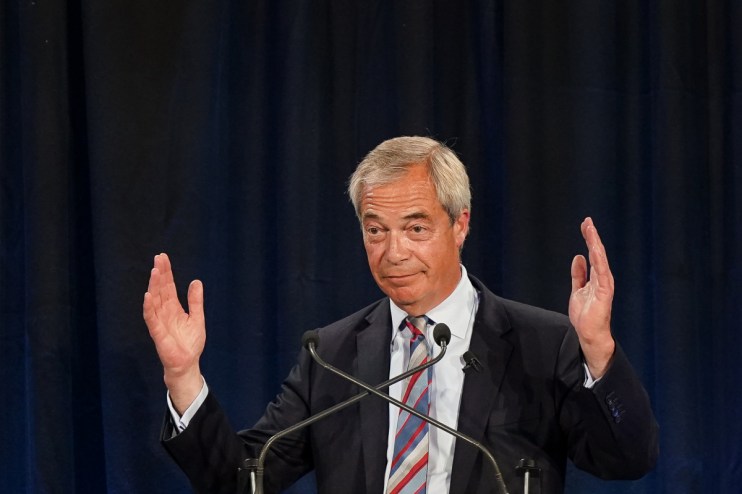
Nigel Farage’s economic policies are neurasthenically inconsistent, but he has opened the door to a debate we need to have about whether Gordon Brown’s settlement for the Bank of England is fit for purpose, says Eliot Wilson
Nigel Farage is a practised veteran at grabbing the headlines with a provocative-sounding but ultimately empty remark. Speaking to Bloomberg’s Mishal Husain recently, he raised the tenure of the Governor of the Bank of England, Andrew Bailey, and the institution’s independence from government.
Exuding his usual beery bonhomie, the Reform UK leader suggested that, if he became Prime Minister, he might seek to replace Bailey.
“He’s had a good run, we might find someone new… he’s a nice enough bloke.”
It was classic Farage, projecting a kind of unforced common sense without overt malice, but it conceals two significant flaws. The first is that Bailey’s term as Governor of the Bank of England comes to an end in March 2028 and is not renewable. However well Reform UK is performing in the opinion polls, the next general election need not be held until July 2029, and with Labour’s current approval ratings it is hard to see a rationale for Sir Keir Starmer gambling on an early contest. The likelihood is that Starmer will be the Prime Minister choosing Bailey’s successor.
In any event, the Prime Minister does not currently have the power to dismiss the Governor at will. Under the Bank of England Act 1998, the Governor can only be removed by the Court of Directors, and even then only if he or she has been absent for a prolonged period, has become bankrupt or is “unable or unfit to discharge his functions”.
Distrust of institutions
Shadow boxing over Bailey’s future is a way into a much wider debate over the status and independence of the Bank of England. It was nationalised by the post-war Labour government in 1946, but Gordon Brown, within days of becoming Chancellor of the Exchequer in May 1997, announced that the Bank would be given operational independence over monetary policy. This was enacted by the Bank of England Act the following year, which established the Monetary Policy Committee to set interest rates in pursuit of the government’s inflation target.
Removing such an important economic lever from the control of politicians was seen in the 1990s as a sensible, responsible and technocratic measure, representing a faith in impartial experts and a lack of trust in the motivations of politicians. But a countervailing wind can also now be felt, one driven partly by populism and partly by a blanket distrust of institutions and expertise, and Farage has opened his sails to it.
Without making any inescapable commitments, Farage has for some time been exploring the idea of the Bank of England more open to influence by elected politicians. In September, he urged the MPC to lower interest rates in an attempt to spur economic growth, and he has criticised the Bank for its conservative approach to cryptocurrencies. Having described Bailey as a “dinosaur”, he advocated the creation of a strategic reserve of bitcoins, and told Mishal Husain: “The Bank of England, the British government, the regulator – whatever shape that takes – they’ve all got to understand the world is changing, has changed, very, very rapidly.”
This, of course, echoes the attitude of his mentor Donald Trump: the President has been excoriating in his criticism of Jerome Powell, Chairman of the Federal Reserve, and has pressed for cuts in interest rates. Powell’s second term expires in 2026, and five potential successors have been mooted, all of them likely to be more amenable to the administration’s wishes.
Perhaps this is a debate we need to have. The discourse has turned sharply against the kind of arm’s-length quangocracy of which the Bank of England’s operational independence was an important element; you do not need Liz Truss’s elaborate vendetta against “the administrative state” to argue that elected, accountable politicians should have increased influence over a major state institution like the Bank of England.
Richard Tice, Farage’s broad-brush and lightweight Sancho Panza, has previously suggested that HM Treasury should appoint “one or two” government representatives to the Monetary Policy Committee, in addition to the four quasi-independent external members already nominated by the Chancellor.
You do not need Liz Truss’s elaborate vendetta against “the administrative state” to argue that elected, accountable politicians should have increased influence over a major state institution like the Bank of England
The New Labour settlement is nearly 30 years old and it is certainly worth reviewing it through a contemporary lens. It can hardly be argued that the Bank of England has got everything right since 1997, nor that monetary policy was uniformly wrong before that date. While an electoral mandate should not be a constitutional skeleton key, allowing politicians to insert themselves into every aspect of public life, it is legitimate to desire greater accountability and oversight, and more direct influence for the elected government over key elements of the execution of economic policy. But it is a complex and nuanced balancing act, and that is not Nigel Farage’s natural milieu.
Real radicals question the need to have a central bank at all. An agent provocateur might point out that Canada, where the Bank of Canada did not begin operating until 1935, weathered the Great Depression better than the United States, and some argue that the Fed’s decisions in the early years of the downturn exacerbated America’s difficulties.
In the meantime, we are left in a familiar situation. Farage is an agitator and Reform UK’s economic policies are neurasthenically inconsistent, but for opportunistic and partisan reasons, the party has opened the door to a broader, necessary debate. What role can and should the government play in monetary and economic policy? That really would be Starmer’s “complete re-wiring of the British state”.
Eliot Wilson, writer and historian; Senior Fellow for National Security, Coalition for Global Prosperity; Contributing Editor, Defence on the Brink