
‘Alarm bells’ for Bank of England as inflation accelerates to three per cent

Inflation picked up faster than expected at the start of the year, official data shows, as concerns grow about the persistence of price pressures in the economy.
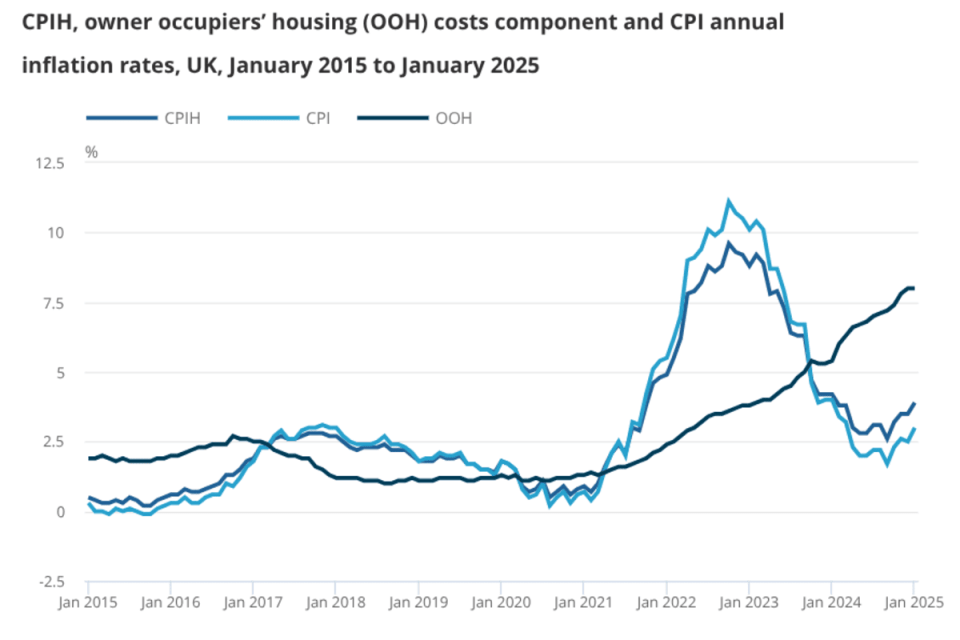
The headline rate of inflation picked up to 3.0 per cent in January, according to new figures from the Office for National Statistics (ONS).
This was up from 2.5 per cent in December and above the 2.8 per cent expected by City traders.
“Inflation increased sharply this month to its highest annual rate since March last year,” Grant Fitzner, chief economist at the ONS said.
Services inflation, the most important gauge of domestic price pressures, jumped to 5.0 per cent in January, up from 4.2 per cent in December, albeit slightly below the Bank of England’s forecast.
Core inflation, which strips out volatile components like food and energy, increased to 3.7 per cent, up from 3.2 per cent previously but in line with expectations.
“The leap in CPI inflation was no surprise, but it was larger than everyone expected,” Ruth Gregory, deputy chief UK economist at Capital Economics said.
Airfares to blame
The ONS said that airfares were a key factor behind the increase in inflation. Airfares tend to rise in December and fall in January, but the trend was “less pronounced” this year, it said.
This is because December’s data was collected on days which traditionally see lower demand, like Christmas Eve and New Year’s Eve, which meant prices were lower.
So although prices did fall in January, it was from a lower base. Airfares fell by 19.0 per cent in January, compared to negative 38.9 per cent a year ago
“The rise was driven by air fares not falling as much as we usually see at this time of year, partly impacted by the timing of flights over Christmas and New Year,” Fitzner said.
Other factors driving the overall increase in inflation were the introduction of VAT on private school fees, which saw prices rise by 13 per cent in the month, having not increased at all last year.
Prices for food and non-alcoholic drinks also rose at a faster pace than last year, particularly for meat, bread and cereals.
Concern for Bank of England
The figures come a day after new figures showed an acceleration in wage growth in the final three months of last year, which took regular private sector pay to its highest level since November 2023.
Combined with an uptick in inflation, the figures point to the lingering inflationary risks facing the UK economy, which will force the Bank of England to only cut interest rates at a “gradual” pace.
Zara Noakes, global market analyst at JP Morgan Asset Management, said the figures will “raise alarm bells at Threadneedle Street”.
The Bank of England expects inflation to continue rising throughout the year. Its latest forecasts indicate that inflation will peak at 3.7 per cent later this year, fuelled by higher energy prices and rising regulated prices, like water bills and bus fares.
Analysts have also warned that April’s increase in the minimum wage and employers’ national insurance will pile further costs onto businesses, potentially forcing them to hike prices.
But Andrew Bailey, Governor of the Bank, said the anticipated increase in inflation was not “a story about the fundamental state of the economy,” because it is largely driven by external dynamics.
The Bank expects to see continued progress on services inflation and wage growth throughout the year, which will enable further interest rate cuts.
“Ultimately today’s reading vindicates the Bank of England’s slow and steady approach to rate cutting,” Michael Field, chief equity strategist at Morningstar said.
Markets anticipate two more rate cuts this year.
Growth in danger?
Higher inflation will put the government’s growth agenda at risk, as it will likely constrain consumer spending and could also jeopardise future interest rate cuts.
“Today’s inflation figures mean further pain for family finances – and it’s thanks to the Labour Chancellor’s record tax hikes and inflation busting pay rises,” Shadow Chancellor Mel Stride said.
At three per cent, inflation was still “tolerably low”, Jullian Jessop, an independent economist, said. But he warned that further increases could “undermine the foundations of any recovery in consumer and spending”.
Consumer confidence has been in the doldrums since the Budget, as a result of the government’s gloomy economic rhetoric and the ensuing £40bn tax hike.
Most economists think any recovery in growth this year requires a stronger picture on the consumer side.
Further upside risks to inflation are likely to feed through from April, when firms will start dealing with the combined impact of the national insurance increase and a higher minimum wage.
“The private sector must determine its response to significantly higher employment costs, and this may well push up consumer prices,” Roger Barker, director of policy at the Institute of Directors said.
In response to the figures, Chancellor Rachel Reeves said the government was going “further and faster” to deliver economic growth.
“By taking on the blockers to get Britain building again, investing to rebuild our roads, rail and energy infrastructure and ripping up unnecessary regulation, we will kickstart growth, secure well paid jobs and get more pounds in pockets,” she continued.