
How Poland and Vietnam escaped poverty

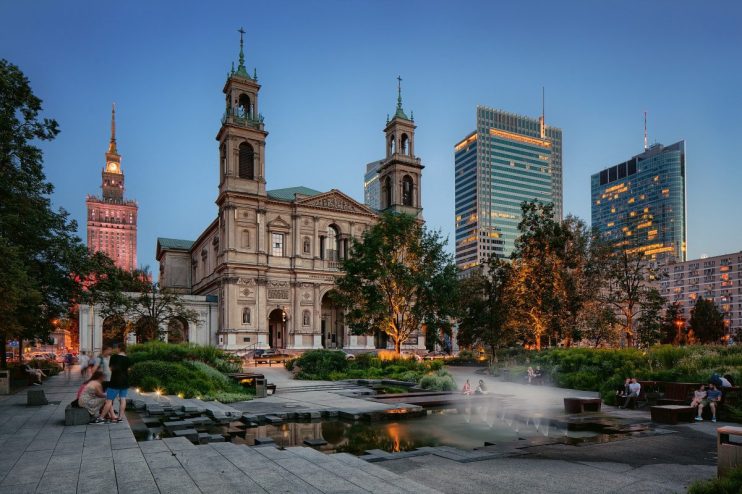
In a new book, Rainer Zitelmann examines how Poland and Vietnam escaped the ravages of the Cold War to become some of the world’s fastest growing economies – and argues that poverty isn’t inevitable, it’s a policy choice says Kristian Niemietz
Case studies in recent economic history typically deal with unambiguous success stories, or unambiguous cautionary tales: countries that are either much richer, or much poorer, than their neighbours.
If you chose that approach, you would have picked neither Poland nor Vietnam as case studies. Neither is particularly remarkable by regional standards. Poland is about as wealthy as the Czech Republic, Slovakia, Hungary and Lithuania. Vietnam, meanwhile, is not as poor as Laos and Cambodia, but poorer than China and Thailand.
But if we look at relative changes over time, we get a very different picture. Over the past 30-odd years, both Poland and Vietnam have been among the world’s fastest-growing economies, albeit from a low base. During the same period, they have also been among the world’s most ambitious economic liberalisers, albeit, again, from a low base, starting as planned socialist economies. Both are case studies in post-socialist transitions: in Poland’s case, towards a Western-style market-economy, and in Vietnam’s case, towards a mixed economy with major market elements.
In his new book How Nations Escape Poverty: Vietnam, Poland, and the Origins of Prosperity, Dr Rainer Zitelmann shows how these economic transformations happened and what the consequences were.
Vietnam abandons socialism
Let’s start with Vietnam. It is no surprise that in the mid-1970s, when the ravages of the Vietnam War had just come to an end, Vietnam was one of the world’s poorest countries. What is more noteworthy is that over the next decade or so, things refused to get any better.
When faced with such economic failure, what socialist regimes usually do is blame imaginary ‘saboteurs’, ‘wreckers’, ‘hoarders’ and ‘speculators’, and double down: this is when the authoritarian, Stalinist tendencies inherent in socialism come to the fore. We could very easily imagine an alternative universe in which Vietnam took the North Korean route. But something very different happened instead. At a party conference in late 1986, the ruling Communist Party of Vietnam decided to abandon its current economic model, and replace it with what they called a “socialist-oriented market economy”. This became the starting point of the “Đổi Mới” (renovation) reforms.
Đổi Mới did not look like the post-socialist transitions we would see in Central and Eastern Europe a few years later. It did not initially involve large-scale privatisations. Rather, it meant the creation of an economy in which state-owned enterprises remained the largest actors, but in which their activities were guided more by market prices rather than the traditional five-year plans. Today, if you type “Vietnam five” into Google, Google suggests “Vietnam five-star hotels” before “Vietnam five-year plans”. That is a good thing. (Although it would be even better if five-year plans disappeared altogether: they still exist.)
Today, if you type “Vietnam five” into Google, Google suggests “Vietnam five-star hotels” before “Vietnam five-year plans”. That is a good thing
State-owned enterprises were given greater autonomy and responsibility so that they could act more or less like private ones. Genuinely private companies were also legalised, initially only on a minor scale, but that limit was gradually raised. The result was that a private sector sprang up around the state sector.
In the 1990s, this internal liberalisation was complemented by an external one: Vietnam allowed private foreign investment and dropped the state monopoly over foreign trade. In the 2000s, privatisation finally became a part of the transition, although the Vietnamese state is still involved in a large number of companies.
In many areas, especially when it comes to the rule of law and the legal system, Vietnam still has a lot of work to do: nobody would describe Vietnam as a role model to be emulated. But it is all relative. Compared to the late 1980s or early 1990s, Vietnam is an unrecognisably different country. The absolute poverty rate dropped from close to 80 per cent of the population to about five per cent today and average life expectancy has shot up by more than a decade.
Poland blazes a trail
The economic transition of Poland looked very different. 1980s Poland was not destitute in the way Vietnam was, but it was an economy plagued by endemic shortages and low productivity – even more so than most of its Eastern Bloc neighbours.
Poland was also a trailblazer of political and economic reform. While the fall of the Berlin Wall is generally considered the starting point of the unravelling of the Eastern Bloc, Poland was actually ahead of East Germany at that stage.
Starting in 1989, a series of company laws created the legal underpinnings of an emergent private sector, while prices were liberalised and the economy was opened up. A mass privatisation programme was brought underway alongside. It was a shock therapy of sorts – but it worked. Despite an initial contraction, Poland’s economy began to recover from 1992 onwards.
Poland is not a role model either. There are still too many state-owned enterprises, taxes and public expenditure are higher than what seems appropriate for an economy at that income level, and on conventional measures such as the Ease of Doing Business Index, Poland ranks rather poorly. But, again, it is all relative. Poland is now about two and a half times richer than it was in 1989. Unlike Vietnam, where liberalisation was limited to the economic sphere, it is also a multi-party democracy with free elections.
How Nations Escape Poverty strikes a good balance between eyewitness accounts, macroeconomic data, academic studies and, simply, an accessible description of economic reforms that most Western readers will not know much about. It shows that there is nothing inevitable about poverty and economic underdevelopment: they are a policy choice.
Dr Kristian Niemietz is the Editorial Director and Head of Political Economy at the Institute of Economic Affairs (IEA)