Skip to content
Saturday 25 July 2026London --:--Frankfurt --:--Zurich --:--
NewslettersSearchEN · DE
City PM

European business, markets and politics

FTSE 100
10,736.23
+0.91%
DAX
25,099.00
+1.36%
CAC 40
8,372.28
+0.88%
STOXX 50
6,280.94
+1.14%
  • Europe
  • Markets
  • Business
  • Economy
  • Technology
  • Politics
  • Opinion
More
GermanyFranceBankingAIEnergyFintechPropertyCapital Markets
  • Germany
  • France
  • Europe
  • Markets
  • Business
  • Economy
  • Technology
  • Politics
  • Opinion
  • DE
Friday 19 February 2016 12:05 am

High house prices and strong rent growth lift landlord returns


By: Chris Papadopoullos

Add as a preferred source on Google

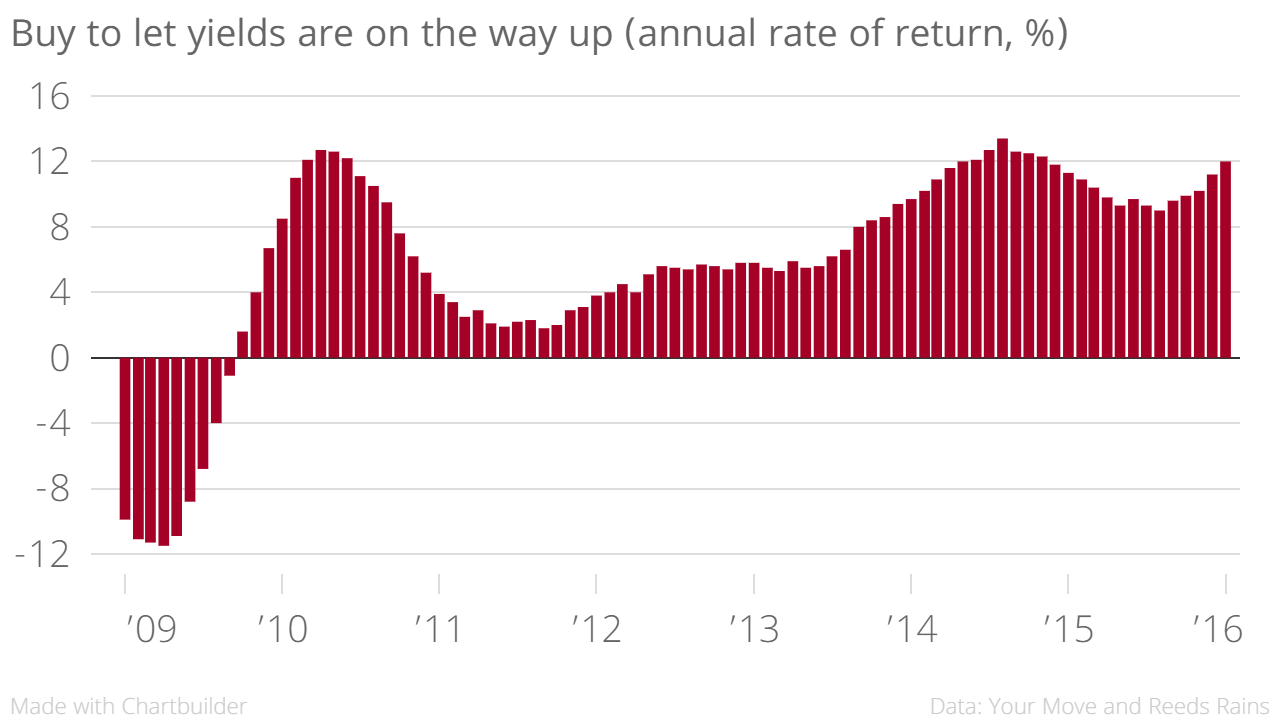
Landlords' annual returns have reached their highest for over a year, according to figures released this morning.

Considering both the growth in rents and increases in property prices, landlords’ annual rate of return in January was 12 per cent.

The figures, from estate agents Your Move and Reeds Rains, show that the average landlord in England and Wales have made a return of £21,988 over the last 12 months, before deductions such as maintenance and mortgage payments.

Rising property prices contributed £13,596 to this while rental income made up £8,394.

“Buy to let returns are building and property prices are picking up as the housing shortage across the UK intensifies,” said Adrian Gill, director of Your Move and Reeds Rains estate agents.

But the year ahead has a few bumps in the road for buy to let investors, such as a higher rate of stamp duty on their property purchases.

“Stamp duty premiums on new buy to let purchases are the rhino in the room – everyone is talking about the 1 April deadline and the extra purchase costs are perceived by some commentators as potentially hazardous. But this is a little simplistic.”

“The rules around UK property are changing – but there is no bull in the buy-to-let china shop.

He said the removal of tax relief on mortgage interest payments would have a bigger impact on landlords. Buy to let investors used to be able to subtract interest payments on their mortgages from the income revenue, reducing their tax burden. This new system will be phased in from 2017.

“Right now in 2016 the big shift is likely to be in favour of existing landlords, potentially at the expense of those planning to start up as a landlord for the first time or expand their portfolio. As such, it will be interesting to see how the rental market responds if there is a disruption to investment in supply,” Gill said.
Share this article

  • Facebook
  • X
  • LinkedIn
  • WhatsApp
  • Email

Similarly tagged content:

Sections

  • Markets & Economics
  • News

Categories

  • Business
  • Economics

Trending Articles

  • BT braces for loss of 800,000 customers as it banks on fibre to keep turnaround ‘on track’

  • Wise denied US banking licence in blow to expansion plans

  • Regulator flags BDO’s ‘unacceptable’ audit issues for fifth year in a row 

  • Scotch whisky sales are falling, but what’s really behind the decline?

  • Housebuilder hits a wall: How did Vistry become the UK’s most shorted stock?

More from City PM

  • Would a Burnham premiership deepen the North-South housing divide?

    Property
    Andy Burnham returns to Parliament
  • Foxtons shares tumble as estate agent takes £3m knock from Renters’ Rights Act

    Property
    Foxtons is London's largest lettings agency brand
  • House prices rise as mortgage rates ease from Iran war highs

    Property
    Starmer plans to build up to 12 new towns.
  • London house prices fall again as property slowdown drags on

    Property
    Two people looking at real estate listings in an estate agents window, showcasing properties for sale.
  • PropertyStream and Offr Launch TRANSACT as UK Homebuying Enters the Digital Era

    Business Wire
  • Barratt Redrow urges Burnham to slash tax to boost housebuilders

    Property
    Barratt and Redrow partnership announcement showcasing executives shaking hands in a modern office setting
  • Workspace urges investors to block ‘destructive’ Saba proposals

    Property
    Workspace Group said occupancy was down very slightly to 88.1 per cent, compared to 88.4 per cent at the end of last year. 
  • Housebuilders urge Rayner to ‘hit the ground running’ and rip up planning red tape

    Property
    Angela Rayner, Deputy Leader of the Labour Party, smiling in glasses at an event with camera crew and lighting
CityPM

Independent European business, markets and political news for decision-makers.

Morning Briefing

Europe

  • Germany
  • France
  • Europe
  • UK & Ireland

Business

  • Markets
  • Banking
  • Technology
  • Energy
  • Property
  • Fintech

Editorial

  • Opinion
  • Editorial Policy
  • Corrections
  • Contact

Company

  • About City PM
  • Privacy Policy
  • Terms of Use
  • Cookie Policy
© 2026 City PM Ltd · Published by CityPM Media, Bahnhofstrasse 65, 8001 Zürich, Switzerland
Privacy · Terms · Cookies · Facebook