
Has Labour overdone the doom and gloom?


Rachel Reeves attempted to pivot to a slightly more optimistic tone in her first conference speech as Chancellor, having been criticised for overdoing the doom and gloom.
After winning the election, the government piled on the warnings of a “painful” budget ahead that would require “difficult decisions.”
Many economists and City business groups have argued that this risks damaging growth. After all, why would households spend and businesses invest in a climate of fear?
Andy Haldane, former chief economist at the Bank of England, argued that Labour’s creation of a sense of “fear and foreboding” was “unnecessary and probably economically unhelpful.”
The clinching evidence came last week when GfK’s consumer confidence index slumped during September, supposedly due to fears about looming tax rises.
So, has Reeves inadvertently talked the economy into a downturn?
There are reasons to be doubtful.
For a start we should note there is not a particularly strong correlation between measures of confidence and economic activity, particularly month-by-month.
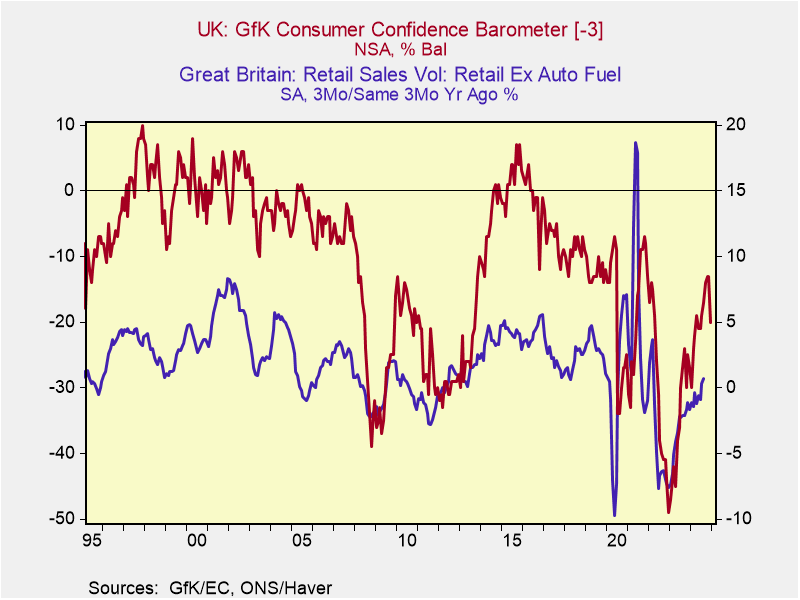
“People still consume essentials and enjoy leisure activities even when they feel gloomy,” Dean Turner, chief investment officer at UBS said.
On the business side, multiple business surveys this year have pointed to improving confidence levels even while investment remains stagnant.
Last week’s reading is, therefore, not too much to worry about. To paraphrase Aristotle, one bad consumer confidence reading does not make a recession.
Looking more broadly, there are multiple examples where rhetoric has had no discernible impact on the underlying economy.
Remember the longest recession in the UK’s history from which the economy is only just recovering from? No, me neither.
But cast your mind back to November 2022, and that’s exactly what the Bank of England was forecasting.
And try looking for Boris Johnson’s Nike ‘swoosh’ in the graph below, which demonstrates our rapid and sustained growth after we finally left the clutches of the EU.
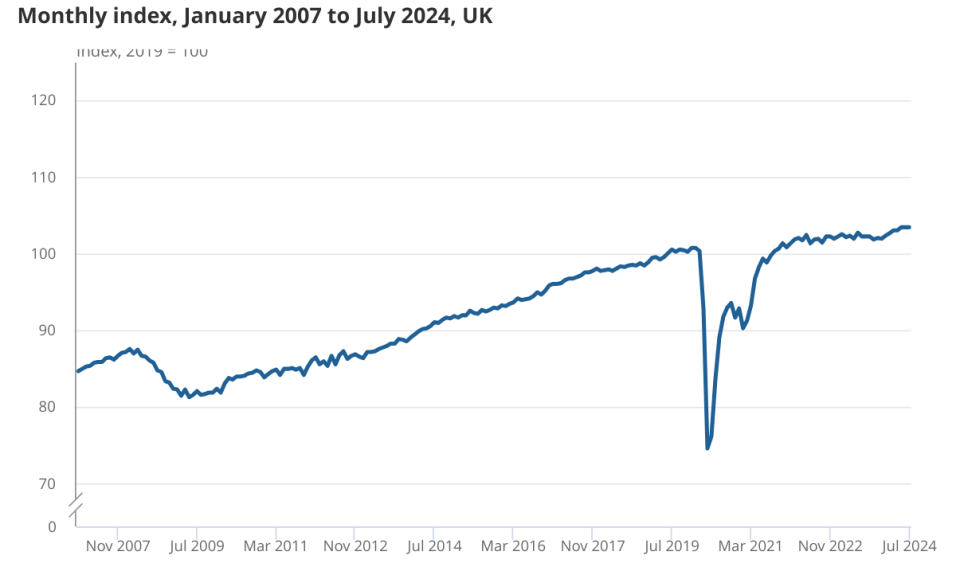
Neither of these examples is meant to show that rhetoric does not matter at all, but clearly, there is an underlying reality that matters a great deal more.
To the extent that political rhetoric can shape economic realities, it must at least reflect the underlying picture fairly accurately.
Put another way, households and businesses have a relatively good BS detector (God knows they’ve had to use it a lot recently). If the rhetoric doesn’t pass the BS test, it won’t have much of an impact on the fundamentals.
There’s no doubt that the new government is being very gloomy, particularly about the fiscal inheritance. But there are also good reasons to be gloomy, which many households are aware of.
Based on the government’s current policies, the Office for Budget Responsibility (OBR) forecasts that government debt will reach 270 per cent of GDP by the mid-2070s.
Of course, debt will never reach that level. As David Miles, a senior official at the OBR, said: “At some point it will blow up”.
Indeed, the House of Lords’ economic affairs committee urged the government to face the “grim reality” of an ever increasing national debt (and nobody had a go at them for doom-mongering).
Given this broader context, it is not unreasonable for Reeves to be lamenting her fiscal inheritance and planning tax rises. You might even say it was economically prudent.
There is a legitimate debate about whether the government’s priority should be cutting spending rather than raising taxes, but it seems unlikely this would make any difference to the consumer confidence readings.
Having said all this, the government can and should do a better job at offering a positive vision alongside its realistic assessment of the public finances. Just don’t expect a compelling vision to turn the UK into an island of prosperity overnight.