

Lured by the promise of opportunities for education and gainful employment, more and more Indian nationals have arrived in Germany in recent years.
Unfortunately, many are then confronted by a harsh reality that is a world apart from the better life they imagined would be waiting in the Bundesrepublik.
Some private universities turn out to essentially be scams, and for job-seekers the German market is notoriously hard to break into, especially for newly arrived foreigners with limited German language skills. Meanwhile the comparatively high cost of living can push immigrants into exploitative jobs.
the publication spoke with Aju John, a researcher and activist who is keenly focused on the challenges South Asian immigrant workers face in Germany.
A former lawyer in India and current PhD scholar in Berlin researching migration and labour issues, John argues that the mis-treatment of these workers is a systemic issue.
From India to Germany: The promise versus the reality
There has been a notable surge in the number of Indian nationals coming to Germany in recent years. This was initially fuelled by a 2022 Germany-India migration agreement, and then further strengthened by measures meant to attract skilled workers – such as the creation of the Opportunity Card visa – introduced by Germany’s former ‘traffic light’ government.
But even for skilled workers with experience, landing a job in their field of expertise in Germany is tough.
While they settle in and begin their job hunts, many recent arrivals from India or South Asia quickly fall into a debt trap.
“The cost of moving to Germany on a student visa or on the Opportunity Card is in the vicinity of €20,000,” John said, adding that at least €12,000 of that goes straight to a ‘blocked account’, which is a common visa requirement. The rest is quickly eaten up by moving, housing and living costs.
For Indians coming from a middle or working class background, this is an enormous sum.
"Nearly all of them are indebted even before they set foot in Germany," John said, adding that having debt makes people "prepared to accept all manner of indignities".
On top of high entry costs comes a number of hurdles, including; tough requirements to enter the workforce (such as German language requirements, even for ‘English’ jobs), short-term visa renewals (often limited to six months), and a severe affordable housing shortage.
For incoming students an additional trap is what John calls “sham” private universities, which come with high tuition costs, but fall short on their own promises. One such school saw hundreds of students ordered to leave Germany after it lost accreditation with Berlin authorities.
Exploitative work schemes
Without work, in debt and struggling to meet monthly living costs, many Indian students and young professionals end up turning to contract and gig-work – much of which is arguably designed to prey on vulnerable immigrants.
Delivery services – such as Wolt, Lieferando, UberEats or Amazon – are some of the best known examples of companies built on the backs of an exploited workforce. But few understand exactly how predatory the industry can be.
John explained that delivery companies get around basic worker protections in German labour law – including the minimum wage – by outsourcing their workforce to sub-contractors which hire and manage on-the-ground workers. Meanwhile these sub-contractors engage in all kinds of exploitative and legally dubious tactics.
John described people being forced into a “pay-to-work model”, where they have to pay up to €500 upfront and surrender 25 to 50 percent of their monthly salary just to access an app that they need to do their job.
Workers are also often paid in cash, and may see a portion of their owed salary withheld for various reasons. Countless cases of this kind of exploitation have been verified and reported. An ARD Documentary called “Ausgeliefert” provides a thorough overview.
"I don't think people understand the extent to which it's like the 'wild west' of the absence of labour law," John added.

Limiting visas
John notes that among Germany's most exploited workers, a large number hold one of two types of residence permits: student visas and Opportunity Cards.
People with a student visa in Germany are generally prevented from working more than an average of 20 hours per week. So those who need more income than they can earn in 20 hours of work per week may seek under-the-table work.
Opportunity Card holders are similarly limited. Which ironically means that having an Opportunity Card can effectively block workers from opportunities for work that don't fit within the specific limits of the visa.
It’s not only delivery apps that benefit from, and prey upon, immigrant workers. John says that he’s seen similar practices applied in various industries and even within Germany’s biggest firms.
“Let’s say there is a big automobile factory on the outskirts of Berlin,” John said by means of example. “And there is a canteen at this factory…if you were to go to this canteen and see the workers…you’ll see that none of them have work contracts and none of them are paid the minimum wage.
“And almost all of them are on one of these two visas.”
'Strategic' lack of enforcement
Germany is generally known for having strong labour protections – including a liveable minimum wage and basic entitlements to social benefits – many of which were hard-fought by workers’ unions. Therefore it’s striking that there is a large and very visible workforce to whom not even the most basic legal protections seem to apply.
“Here we have no option but to conclude that the non-implementation of the law is definitely strategic,” John said. “Despite the law being quite strictly implemented in several areas of life, in this one particular area of life, the law seems strangely absent.”
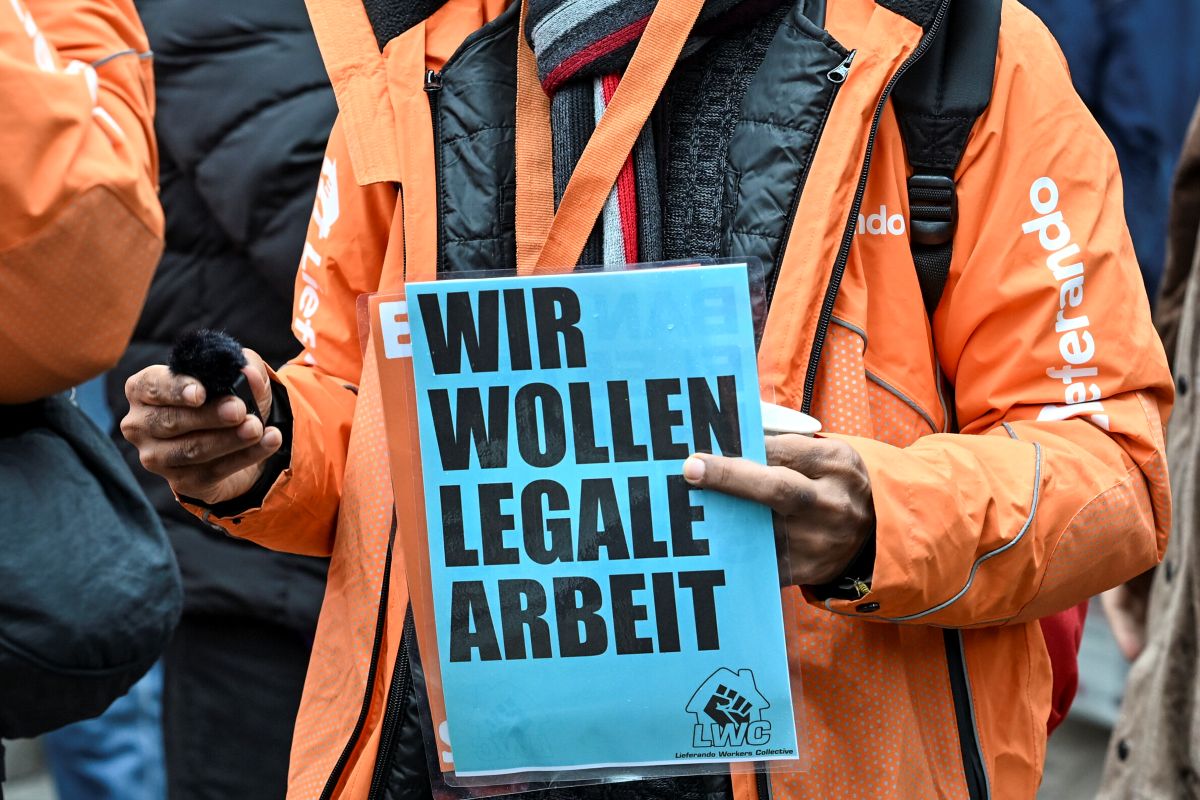
And the strategic aim here is keeping the average wage down, John argues: “Keeping the average wage down means that your Amazon deliveries are cheaper, that your food orders are cheaper, that your shawarma is cheaper…”
Especially now, with so many large German companies struggling to stay competitive, John thinks that keeping average wages down, by whatever means necessary, acts as a kind of bandage to keep the injured economy running.
What needs to change?
John makes clear that there no easy answers, in terms of what can be done, for those who fall victim to these practices: “The problems that [these workers] are experiencing are quite structural…information alone is not going to be sufficient.”
Instead John suggests that making this kind of employment more secure, and bringing it all above board will require political will and a broader enforcement of German law.
To that end, John pointed to this petition “for direct employment” brought by the Lieferando Workers Collective and the NGG trade union which calls for a mandatory ban on subcontracting.
Additionally, John invites Indian students and workers who are in a tight spot, either financially or regarding their employment, to visit the “Migrant Worker and Student Canteen” where he and others offer free meals as well as advice on immigration and work issues, on a semi-regular basis. You can find more information on these events via the Gerechtarbeit Instagram page.
Aju John also produces and hosts the "Delivery Charge" podcast. You can hear him speak more about the above issues here.


