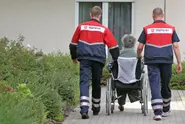
Germany's government is preparing for the possibility of a new civilian service programme, reviving a concept that disappeared after military conscription was suspended in 2011.
The move does not automatically mean that conscription is about to return. But officials have now confirmed they are making plans for an alternative service that conscientious objectors could opt for if conscription were brought back.
The story emerged on Tuesday after the Federal Ministry for Family Affairs confirmed reports it was examining how a future civilian service scheme could operate.
According to the ministry, officials have surveyed 23 major welfare organisations and associations about their ability to accommodate people who refuse military service on conscientious grounds.
A ministry spokesperson said that 22 of the 23 organisations surveyed indicated they would, in principle, be prepared to offer alternative placements.
Also on Tuesday, new CDU/CSU parliamentary group leader Thorsten Frei told RTL that any reintroduction of conscription would require a corresponding alternative service for those unwilling to serve in the armed forces for moral, religious or ethical reasons.
The ministry is expected to present its plans in greater detail after the summer recess.
What exactly is Germany's civilian service?
For many foreign residents, the term Zivildienst may be unfamiliar.
'Civilian service' was Germany's alternative to compulsory military service. For decades, young men who were called up for military service but objected to serving with weapons could perform civilian service instead.
Those carrying out the service were commonly known as 'Zivis'.
Rather than joining the military, they worked in hospitals, nursing homes, care facilities for people with disabilities, ambulance services, youth organisations and other public-interest institutions.
That system came to an end in July 2011 when Germany suspended compulsory military service. Because Zivildienst existed solely as an alternative to conscription, it was abolished at the same time.
To help replace the workforce previously provided by Zivis, Germany introduced the Federal Volunteer Service (Bundesfreiwilligendienst or BFD), which is entirely voluntary and open to people of all ages and genders.
Other voluntary programmes, including the Voluntary Social Year (Freiwilliges Soziales Jahr or FSJ) and Voluntary Ecological Year (Freiwilliges Ökologisches Jahr or FÖJ), also offer opportunities for people wanting to work in social, environmental and community projects.
Will Germany bring back conscription?
The preparations for the possible return of civilian service come against the backdrop of Germany's wider military reforms.
At the beginning of 2026, the country introduced a new military service framework aimed at boosting recruitment for the Bundeswehr. The system includes mandatory questionnaires for young men and, from July 2027, compulsory medical examinations for men born in 2008 or later.
The stated goal is to recruit enough volunteers to meet Germany's revised military targets. But the legislation leaves open the possibility of additional compulsory measures if volunteer numbers fall short.
One senior CDU politician recently revealed that Germany could revive conscription by mid-2027.
Exactly what that would look like remains an open question. One proposal discussed publicly is a lottery system, although legal concerns about the fairness of this approach remain unresolved.
Germany's political parties remain divided on the question. According to analysis by the International Centre for Defence and Security (ICDS), the conservative CDU/CSU favours a stronger compulsory element and has expressed support for a lottery-style system.
Their coalition partners in the centre-left SPD prefer to focus on attracting volunteers.
Opinion within the Greens is reportedly mixed, with some figures supporting a voluntary model and others advocating a broader national service year that could include military or civilian options.
The Left Party opposes compulsory service entirely, while the far-right Alternative for Germany (AfD) has yet to settle on a clear position.