
It is no secret that in recent years, every major group and investment fund has sought to acquire “the world’s best shirtmaker.” Yet until now, the Colban siblings, who own Charvet, had resisted. So how did Chanel manage to win them over?
“To be honest, I think it was more they who chose us, after putting us to the test,” said Bruno Pavlovsky, president of Chanel’s fashion division, a few days ago in his office on Rue Cambon. In business, he says, you sometimes have to let yourself be charmed.
“This acquisition did not stem from a corporate strategy, but from a human story, a meeting of minds around a project rooted in craftsmanship. If Matthieu [Blazy, Chanel’s creative director] had not been there, I do not know if this partnership would have happened. Would Jean-Claude [Colban] have called me? Would I have answered?” Pavlovsky says before correcting himself: “Yes, I certainly would have answered; I would have gone to see what we could do.”

Let us rewind. Matthieu Blazy, who was appointed as Chanel’s creative director just over a year ago, made headlines in early October with his first runway show for the brand; he notably unveiled an unexpected partnership with Charvet, centered on women’s shirts. Unexpected, not because the specialist is below this level of luxury (on the contrary), but because Chanel has never engaged in collaborations — unlike its competitors.
In fact, it was not a collaboration in the strict sense of the word; rather, an order placed with this expert in the field. “When he first arrived, it took Matthieu a little while to figure out the angle for his first collection,” Pavlovsky says. “Until he stumbled upon archival documents showing that Gabrielle Chanel had been a client of Charvet, an institution she was introduced to by Boy Capel [the great love of her life, who died tragically in 1919].”
Unparalleled expertise
The Franco-Belgian designer, known for his refined yet classic taste, Blazy is himself a client of Charvet. That was the turning point: He had found his own “Gabrielle,” the lover and the ambitious woman, who wanted the very best of what is usually reserved for men. That includes, among other things, shirts.
“As with everything we do, we wanted to work with the best,” Pavlovsky says without a trace of false modesty. “We were not going to copy Charvet, who is our neighbor. In any case, it was not something that could be copied. Their craftsmanship is unmatched.” So one of the first steps he took with Blazy, in the spring of 2025, was to go meet with the owners of Charvet.
Jean-Claude and Anne-Marie Colban took over from their father, Denis Colban, some 30 years ago. He had been a longtime supplier to the house founded in 1838 by Joseph-Christophe Charvet, son of Napoleon I’s “wardrobe curator.” When, in 1965, the Charvet heirs considered selling the family business to an American, Charles de Gaulle — who was a Charvet client — demanded a French buyer. Tasked with the matter, the Minister of Industry approached Denis Colban, who, driven by his passion for the craft, decided to purchase Charvet himself.
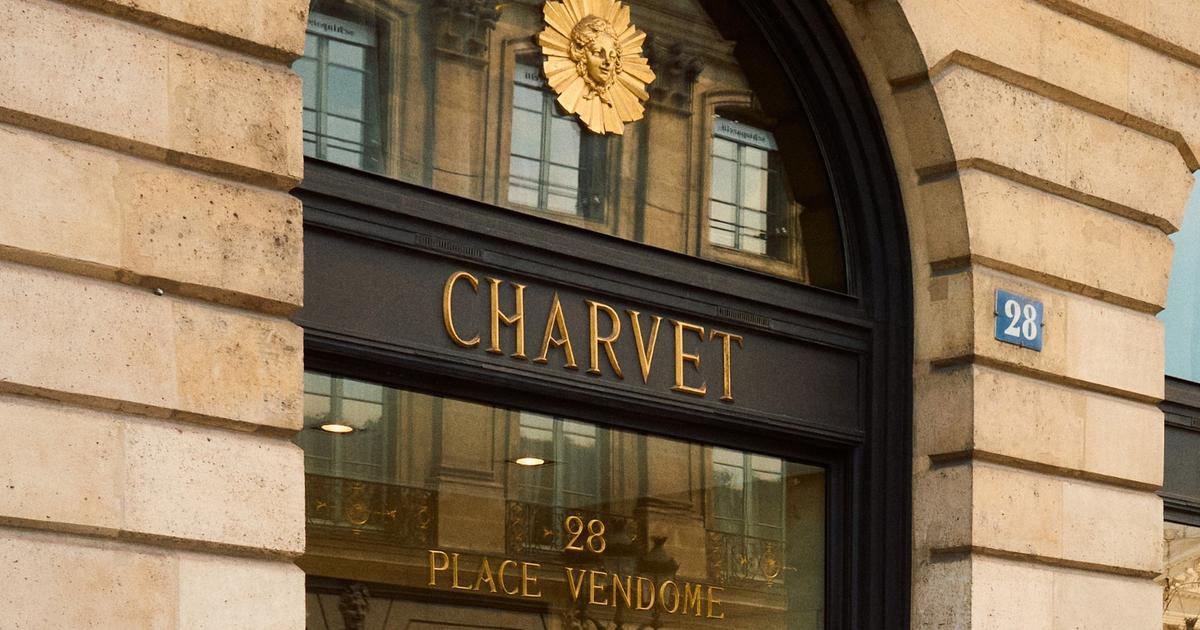
It was a stroke of genius in many respects, especially as he secured a location on Place Vendôme in the process. Better yet, to expand the store in 1982, he moved to number 28 on the Place, occupying the six floors of the Hôtel Gaillard de la Bouëxière, one of the capital’s most prestigious addresses.

The Colbans — who, unbeknownst to anyone at the time, were wondering about the future of their business because their heirs were not interested — therefore agreed to produce the prototypes of the designs created by Chanel for the fashion show. However, the 60 or so artisans in their workshops in Saint-Gaultier, in central France, could not complete production on time, while also fulfilling orders from Charvet’s regular clients.
They then decided to establish a partnership with Chanel. “This allowed us to produce 1,000 pieces, but the shirts were so successful that we could have supplied 10 times as many. But the idea was not to flood the market either. That is the whole point of this partnership with Charvet.”
During those weeks when the teams from the two neighboring institutions worked together, Jean-Claude Colban took the opportunity to casually ask Pavlovsky for advice on business matters — which is why Pavlovsky says, in hindsight and with a certain warmth, that he was “put to the test.”
Tested to ensure that Chanel understood the uniqueness of this traditional (in the best sense of the term) tailor. While the future is never certain, the deal, presented as “a smooth transition,” does not call for opening Charvet stores in every capital city around the world or for increasing productivity.
The slow art of bespoke tailoring
Beyond the remarkable expertise, there is an indefinable, almost Proustian charm (the author of “In Search of Lost Time” was a client) to the boutique. In this temple of the shirt, home to thousands of fabrics in an infinite array of shades — hundreds of blues, pinks and whites — sales staff can accommodate only about 10 customers at a time.

“But if you make an appointment, say, for 10 a.m., Anne-Marie will take care of you in a way that you will never experience anywhere else. And if you let it happen, you will still be there at 3 p.m. and might end up with dozens of gorgeous shirts, ties and pairs of socks [laughs]. In addition to being consummate professionals, they are incredible storytellers, with a level of discretion that has become a rarity.”
Pavlovsky speaks from experience. Every time this busy modern executive has walked through Charvet’s doors in recent months, he has had to reset his mind to “take his time.” Quite simply. “It is the kind of moment that forces you to dive into greater detail than anyone is used to anymore,” he continues, almost pensively.
When asked whether Charvet’s success rests on a trade secret or on craftsmanship, he replies: “Craftsmanship, certainly. And the secret is that no one else takes the time to do things with as much care and dedication as they do.”
Pavlovsky clearly sees how Chanel can support Charvet over the long term. “With the same approach as our haute couture,” he says. “Since Charvet, which is very well managed, is not losing money, the issue isn’t about the numbers, but about preserving an extraordinary place where customers, especially international ones, can find exceptional products and a unique experience during their stay in Paris. “This philosophy aligns with ours; we seek to offer increasingly specific and unique experiences.”

One of the interesting aspects of this partnership is that Chanel is an exclusively women’s brand but is increasingly worn by men (primarily jackets and leather goods), while Charvet caters primarily to men but is adored by women. For both brands, this is far from a problem: “What is important is offering the best product and ensuring that everyone finds what they are looking for.”
Preserving the house’s spirit
The negotiations also established that Charvet’s business was inseparable from its location on Place Vendôme and its workshop in Saint-Gaultier. “We were not looking to carry out a real estate deal. But, of course, a vacant building on Place Vendôme is so rare that it attracts a great deal of interest. The major risk to Charvet’s long-term future would have been if a buyer had separated the building from the business.”
The other risk would be to “reduce” the specialist to a satellite of Chanel. “We probably will not rule out collaborations if Matthieu wants to work on a new collection; however, we are not acquiring Charvet as a supplier but as a fashion house.”
The shirtmaker thus joins the Chanel group’s galaxy, alongside the French brand Eres (acquired in 1997) and the British swimwear label Orlebar Brown (in 2018), in a different constellation from that of “maisons d’art” (Lemarié, Lesage, Barrie, etc.). Is this an effort to create a Chanel group in the traditional sense?
“One could call it a new form of group, but our focus remains and will remain on Chanel,” replies Pavlovsky. He also speaks of a stimulating collective adventure for the teams, who have the opportunity to move from haute couture at Chanel to the Eres ecosystem and, soon, for some, to Charvet.
“But the biggest challenges facing our industry today are working upstream, on the manufacturing side, and focusing on knowledge transfer and training. These are the crucial issues that will ensure that, in 10 or 20 years, we can continue to have strong brands, consistent products, and a vibrant tradition of craftsmanship.”


