
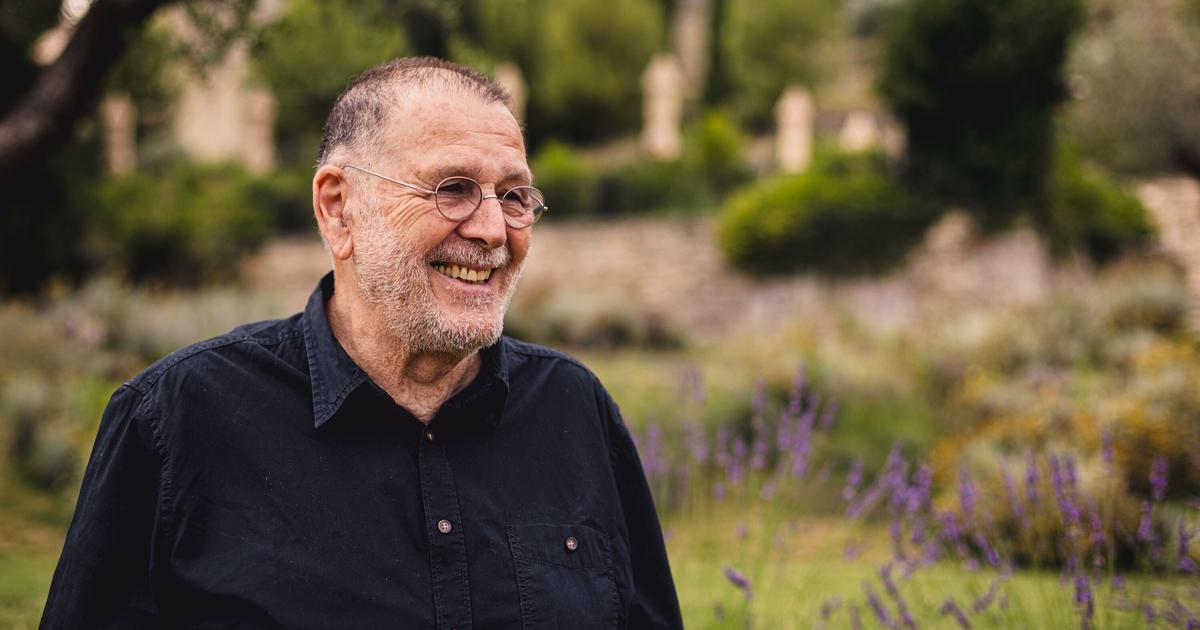
Who exactly is Olivier Baussan? A seasoned entrepreneur who has decided never to put his ventures on hold? A former literary figure who once ran a bookstore dedicated to poetry? An avowed humanist, a man as much of the land as of the region? A personality who loves to bring beautiful stories to life? We would likely have to explore all these angles to truly reach a conclusion. In the meantime, there is nothing quite like meeting him in his natural element and very foundation, Provence.
The first L’Occitane en Provence workshops were opened in Volx, north of Aix-en-Provence, and covered 7,000 square meters (75,350 square feet). Compare that to the 25,000 square meters (269,000 square feet) of the current facilities, located just down the road in Manosque. As the founder of the cosmetics company that has expanded worldwide, Olivier Baussan made a name for himself through this venture.
In Volx, where the original factory has given way to the Écomusée l’Olivier (an ecotourism site), Baussan seems happy to be among the many objects that bear witness to a professional, but also personal, universe, the two spheres being intimately linked. Photos, machines, display cases — an ode to colors and scents — at the heart of a world where olive oil is perhaps the primary element. Even though Baussan has sold L’Occitane en Provence, which is celebrating its 50th anniversary this year, he has never strayed far from it: “Top-tier luxury consultant,” as economic observers might put it, “mentor,” or even “source of inspiration,” as less analytical minds might prefer.
The Aix region
Instead of cosmetics, the entrepreneur is now developing a range of flavors. The Territoire de Provence group (€34 million in revenue) brings together manufacturers specializing in almonds, olive oil, cookies, caramel and chocolate. This includes the Le Roy René brand, known for the famous calissons of Aix, and Brémond Fils, a network of gourmet food stores also hailing from the Aix region. As for pistachios, the latest venture, the goal is clearly to establish a French industry by reintroducing the pistachio tree, which requires little water. It is important to note that this list of activities is not exhaustive; Baussan belongs to that category of entrepreneurs who make the most of every opportunity, quick to spot good ideas and figure out how to bring them to life.
“We are very attached to the term ‘manufacture,’ which is synonymous with the art of craftsmanship,” he says. “We are here to make great products, promote them, and, through them, give new momentum to Provence. The ingredients here are well-known, but are they valued enough?”
Baussan’s father was a journalist at the regional newspaper Le Méridional, and he would not have been opposed to his son following in his footsteps. In fact, Baussan first earned a bachelor’s degree in literature in Aix. “My parents were not from the South. They came from the Paris region. It was a time when the idea of returning to the countryside, connecting with nature, and changing one’s lifestyle resonated strongly,” he recalls.
Although there was no family tradition of pursuing an entrepreneurial career, Baussan recalls at least two formative moments: “I wasn’t very old when I spotted an alembic for sale one day. I started by distilling rosemary to make essential oils, which had some success at the markets. But most importantly, at age 23, I set out on a two-day transhumance in the Luberon. One of the animals was injured, and I watched one of the shepherds gather juniper, improvise an oven, and produce cade oil, which he used to treat the animal.”
This story of crafting a 100% natural remedy, as told by Baussan, becomes almost a fairy tale or a lesson in philosophy. Very quickly, the conversation turns to Jean Giono, Victor Hugo and René Char, authors with whom he shares a genuine closeness, even a sense of kinship, much like any attentive reader. “I admire them because I see in their writing powerful human dramas, long-term projects, and an atmosphere of resilience.”
In Giono’s work, he might add the landscapes that blend beauty and aridity, much like the Valensole plateau, covered in lavender in early summer, to the delight of tens of thousands of visitors — and where the Maison de la Pistache has made its home. “We are in the pistachio business just as we have been in the almond business for much longer — that is, with a commitment to passing on our knowledge and connecting companies and people. Admittedly, we source our supplies from abroad [a company like Le Roy René consumes 200 metric tons of almonds per year for its calissons and nougats]. But there is room for plantations in the region, provided we can build a cohesive ecosystem.” That means reaching out to farmers, forging close ties, and launching small-scale productions with the hope that they will grow.
Continuity
From the very beginning, Baussan has enjoyed working as part of a team or even as a duo; his wife, Nadette, an illustrator, brings her own touch to the product lines, with packaging being the first element to attract customers. Over time, former colleagues from L’Occitane en Provence have joined the entrepreneur at Territoire de Provence. While he embraces his creative side, he is quick to point out that he needs support, a strong team around him, to grow with confidence. In short, he needs people around him who can help channel his boundless energy. Marie-Claire Maurin, his trusted assistant at L’Occitane en Provence, is among those who embody this continuity. Her son, Ugo Martinez, is now CEO of Territoire de Provence and is set to eventually take full charge of operations. This will be done in close collaboration with Baussan’s family, who will remain shareholders of the company.
“Continuity is necessarily a concern. We must not be afraid to put everything that will define the future on the table. I am 74 years old; I am not going to say I am retired, because I have never really retired, but I know the need to plan for the future,” Baussan says, drawing a parallel with the life cycle of trees, such as the pistachio tree, which does not bear flowers or fruit for an average of six years after it is planted.
With Olivier Baussan, we could have talked even more about his love for Corsica — where he recharges his batteries — for Japanese poetry, and for long-distance travels in search of flavors and quality products. Yet we know full well that the conversation would never be sugar-coated; the man is a clever blend of faith in his roots and a keen business sense. He has launched brands, faced failures, stumbled and bounced back; he is proof that regionalism is anything but a lost cause when vision is also used to push boundaries.


