
Forget the UK, how has Europe dealt with pro-Palestine marches?

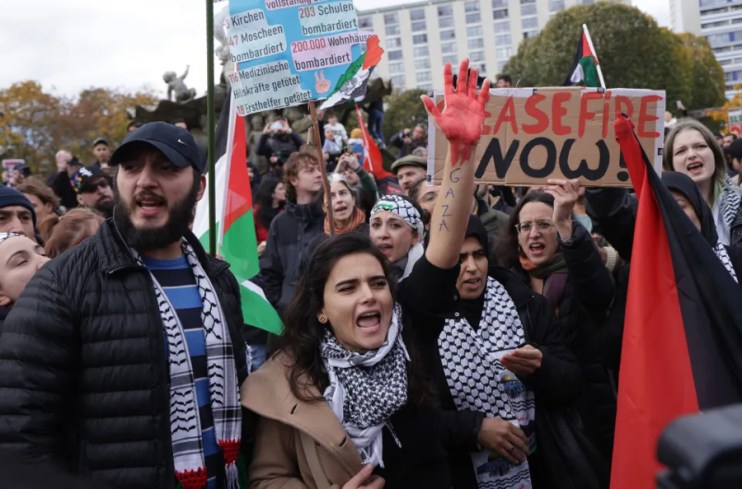
This week a Yougov poll showed half of the UK thinks the pro-Palestine march planned for this Saturday 11 November ought to be banned. The Home Secretary has dubbed it a “hate march”.
The ethics – and law – around banning marches is controversial.
In the UK Sir Mark Rowley, head of the Metropolitan Police said police were unable to ban static protests under UK law. They will only request the power to stop a march if a threat of serious disorder emerges.
But, in this instance, Sir Mark said the “very high” threshold had not been reached and the use of such a power was “incredibly rare”, only to be used if there was no alternative.
So far, the UK has not gone down the route of banning marches, even if Home Secretary Suella Braverman has put her career on the line by questioning the police’s decision. In Europe however, this is not the case. Both France and Germany – the two most influential countries in the EU – both initially banned marches, before being forced to allow certain concessions (known by some as freedom of expression).
Both France and Germany – the two most influential countries in the EU – both initially banned marches, before being forced to allow certain concessions (known by some as freedom of expression).
France
On 12 October, the Thursday after Hamas’s attack on Israel, the French interior minister ordered local authorities to ban pro-Palestinian demonstrations.
Gerald Darmanin said marches were “likely to generate disturbances to public order”.
Pro-Palestinian protestors subsequently defied the ban to march in Paris resulting in the infamously heavy-handed French police using tear gas and water cannons to disperse of them.
On 18 October France’s top court, the Council of State, ruled France could not ban all of these rallies outright, but that local authorities could choose to ban individual demos.
Just over a week later, an administrative court upheld the anti-demonstration ban citing serious risks of public disorder due to “heightened tensions linked to the events in the Gaza Strip with a rise in anti-Semitic acts in France”.
But local authorities in Paris revoked the permit for the march just 90 minutes before it was due to start and 4,000 people protested anyway.
This gave police permission to hand out fines of 135 euros each to 1,400 people.
In France, there is a particularly delicate history of tensions, that makes the response to the war in Gaza and the subsequent protests all the more complicated.
Last Saturday was one of the first big gatherings in support of Palestine that was legally permitted. Paris chief of police, Laurent Nunez, allowed the march, attended by thousands, whilst pledging any anti-Semitism wouldn’t be tolerated.
In France, there is a particularly delicate history of tensions, that makes the response to the war in Gaza and the subsequent protests all the more complicated.
The French writer Dominique Moisi told The Economist a “conflict of memories” was playing out on the streets of France.
Under the Vichy regime France collaborated with the Nazis during the Second World War and has the third largest Jewish community in the world (500,000 people).
France also has the largest Muslim population of Western Europe (5m).
Over the last decade, France has struggled with policies deemed Islamophobic, including the ban on the Burqa – which is part of a wider ban on any explicit religious symbols in public spaces.
The overflowing of these tensions has led to the horrific attacks like those on the Charlie Hebdo newspaper in 2014 and those on the Bataclan in 2019.
Of the hostages held by Hamas, 17 are believed to be French citizens.
Macron’s reaction
Despite the hardline approach on protests, President Emmanuel Macron has struck a more nuanced tone than many other leaders: he has called on Israel to reflect on the repercussions of a brutal attack on Palestine for Israelis
Macron has been notably nuanced in calling for tolerance at home and abroad.
’’Let us not bring ideological adventures here (to France) by imitation or by projection. Let us not add national fractures … to international fractures,″ Jupiter (as he’s known) pleaded. ’’Let us stay united.″
“Israel has the right to defend itself and the duty to protect its own people,” Macron has said. But the government “also has a clear responsibility… to respect the law and protect civilians,” he added, warning that the humanitarian situation “is worsening more and more each day”.
Yesterday Macron held a humanitarian conference in Paris and rejected Israel’s command for Palestinians in Gaza to move from the north to the south – and said a ceasefire was the only way to save lives.
Germany
Authorities have largely banned pro-Palestinian demonstrations despite Germany’s constitution explicitly permitting peaceful gatherings.
This has been possible due to police citing a high risk of “incitement to hatred” and threat to public safety. Similar to the UK, there is generally a high bar to impose restrictions on freedom of assembly. But the pro-Palestinian marches have been judged to pose “an imminent danger to public safety and order,” which means that the police expected acts of violence and property damage.
Protests continued in spite of this, and occasionally turned violent especially in the district of Neukolln in Berlin which has a high concentration of Muslims and residents with heritage or connections to Arab nations. Police have broken up protests in the capital Berlin and used water cannons and force in clashes with protestors in certain areas.
If France’s history is complicated, Germany’s is an impossible labyrinth,
Last Saturday German police said 9,000 put the turnout at 9,000 in the Berlin demonstration and at 17,000 in Dusseldorf.
Around 174 people were arrested – plus 65 police officers injured – at unauthorised Berlin demonstrations this week. For contrast, only 29 people were arrested in London’s most recent pro-Palestine rally on Saturday 4 November.
If France’s history is complicated, Germany’s is an impossible labyrinth, with the guilt over the Holocaust continuing to cast a long shadow over its foreign policy and relationship with Israel. The phrase Staatsraison – meaning raison d’état – emphasises Germany’s commitment to defending Israel over other states.
Chancellor Olaf Scholz said “The only place for Germany at this moment is at Israel’s side,” reflecting a cross-party view extending even to the left wing parties (typically more pro Palestine).
But Germany also has a significant Muslim population, with many first generation immigrants moving more than 60 years ago. In the wake of Hamas’s attacks on 7 October dozens of Germans in the Muslim-dense area of Neukolln gathered to celebrate the atrocities. Unsurprisingly this left a bitter taste in many Germans’ mouths.
Germany was one of the countries which opposed UN Secretary General Antonio Guterres’s call for a humanitarian ceasefire.
On Wednesday German President Frank-Walter Steinmeier said Germans of Arab and Palestinian descent ought to take action to distance themselves from Hamas and anti-Semitism in the wake of demonstrations.
Switzerland
The famously neutral country moved to ban demonstrations related to the conflict in Zurich and other areas on the week of 18 October.
The authorities said this was because they assessed the “probability of personal injury and property damage during rallies as very high”.
Some Swiss jurisdictions like Basel generally prohibit rallies from taking place.
However, recently ‘free Palestine’ marches have been given the green light in Zurich when accompanied by a heavy police presence.
Spain
Pro-Palestinian marches have taken place in Madrid, Barcelona and other cities without any restrictions.
Spain recently expressed support for UN Secretary General Antonio Guterres’s criticism of Israel’s bombardment on Gaza and the death of over 1,000 Palestinians.