

Familiarity bias: how to overcome the fear of the unfamiliar to reach your investing goals
For the vast majority of people, like you and me, trading is not a full-time job. Though you try to do your best and make impactful investment decisions, you tend to make things “easier” (at least, you think you do so) and gravitate towards the familiar.
In this case you may end up investing in one stock (your favourite brand?) or the stock of the company you work for. Does that sound like a good trading strategy to you? Probably not.
The problem is that a particular financial asset does not necessarily suit your goals just because it seems familiar. Sticking to one or several familiar stocks limits your opportunities as a trader and makes your portfolio undiversified, which significantly increases the risk of losing money.
Familiarity bias: the agony of choosing
Today, there are thousands of stocks available for trading, but estimates suggest that we recognise just 1% of them. How do you choose which stocks to trade?
Theory suggests that you should carefully weigh up the expected return and risk of every single investment. Is that what you really do?
Instead, many trading newbies and even more experienced traders tend to trade stocks they are familiar with. It brings you the delusive comfort of putting your money into a business that you “know”.
Uncovering the familiarity bias, Gur Huberman claims: "Familiarity is associated with a general sense of comfort with the known and discomfort with, even distaste for and fear of, the alien and distant."
This sentiment gives you the wrong impression that familiar investment alternatives are better than unfamiliar ones. You expect that they would bring you higher returns, but you underestimate the risks. Misjudging the risks, you fail to take necessary risk management steps, like diversifying.
How to find stocks for trading
Well, if familiar stocks are not always the best option, how do we decide what to trade?
-
Keep track of the news
If you trade CFDs on shares, you definitely want the ones that are moving and showing a reasonable degree of volatility. Surfing the financial news will give you some active names to look at. Company news – including earnings reports and mergers and acquisitions – could cause significant intraday movements, which bring with them their own buy and sell signals. So, simply following the news may bring you a list of potential trades.
-
Follow the top traded stocks
You don’t have to spend hours researching the most popular stocks among traders. Trading platforms allows you to do it in one click, filtering the top traded stocks for you. Liquid stocks have bigger volume, which makes getting into and out of trades easier and faster.
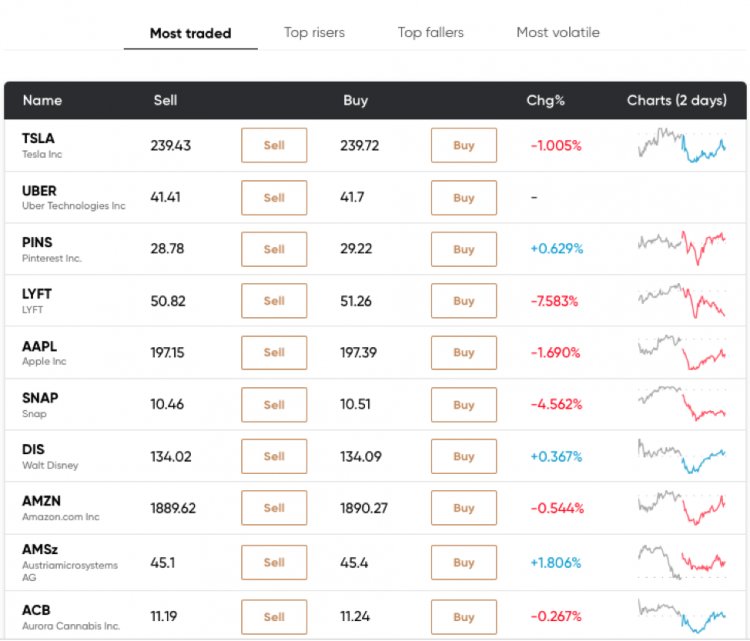
3. Check the top risers and top fallers
The lists of top risers and top fallers will give you the up-to-date picture of uptrending and downtrending stocks. Traders often take long positions on uptrending stocks and short positions on downtrending stocks. However, note that intraday trends don’t continue indefinitely, so use technical indicators, such as the trendlines or moving averages, to spot changing market dynamics.
4. Choose the strongest from an uptrend and the weakest in a downtrend
Very often, when choosing a stock to trade, it’s reasonable to look at the performance of a correlated index. When the index moves higher, traders often look to buy stocks that are moving upwards even more aggressively. They lead the market higher and can provide room to grow. If the market drops down, it might make sense to short sell stocks.
According to Benjamin Graham, the author of “The Intelligent Investor” and one of the world’s most notorious investors, “the investor’s chief problem – even his worst enemy – is likely to be himself”. It doesn’t mean that you are incapable of effective money management, but you should definitely check and analyse your investing approach in order not to fall into the trap of the familiarity bias, which is too common in trading.
Diversification: the ultimate remedy
Traders who diversify are less likely to lose a significant portion of their investments just because a particular company doesn’t perform well. There are 3 major reasons to diversify that you should remember:
-
Different types of investments perform differently at the same time.
-
Diversification allows you to create a portfolio with a smaller risk than a combined risk of trading individual stocks.
-
Different types of investments are differently affected by the world’s political and economic events, creating various investing opportunities.
Diversification of your portfolio – i.e. investing in stocks from different sectors, countries and asset classes – may serve as a good way out and the ultimate remedy that will save you from the familiarity bias.
CFDs are complex instruments and come with a high risk of losing money rapidly due to leverage. 76,2% of retail investor accounts lose money when trading CFDs with this provider. You should consider whether you understand how CFDs work and whether you can afford to take the high risk of losing your money.