
Exclusive: Liz Kendall bets £55bn to close UK innovation gap

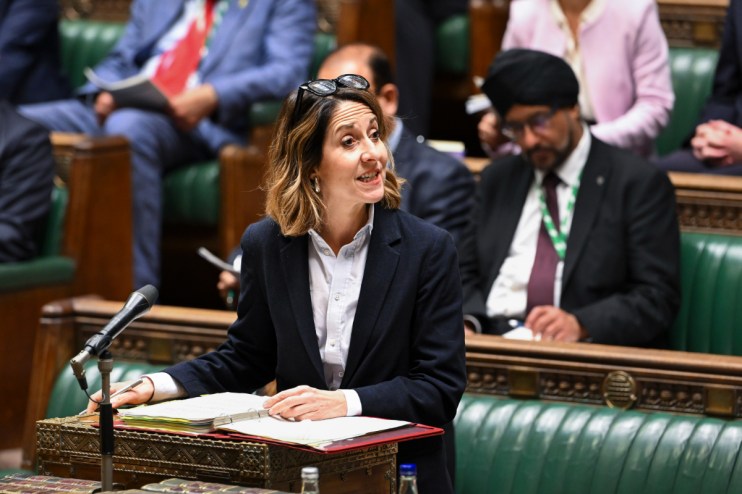
Britain’s new tech secretary, Liz Kendall, insists the government’s record £55bn R&D package marks a turning point for UK innovation, but with the country still lagging global rivals in key sectors, questions remain over whether even this scale of investment can close the gap.
The funding, confirmed on Thursday by the Department for Science, Innovation and Technology (DSIT), sets out multi-year budgets for the UK’s research agencies and innovation bodies through to 2030.
It forms part of the government’s wider Modern Industrial Strategy, which aims to re-anchor growth in science, clean energy and advanced technology.
‘Critical to growing the economy and creating good jobs’
Speaking to City PM, Kendall described the investment as “absolutely critical to growing the economy and creating more good jobs.”
“We know that for every pound of public money that goes into R&D, you get double the amount from the private sector,” she said. “Businesses that get R&D funding grow by 20 per cent more, and they expand their workforce by around 20 per cent more.”
Kendall insisted that her plan was more than headline growth, dubbing it as a necessary step in tackling national challenges such as climate change, healthcare and public service efficiency.
She also said that R&D could “help public services become more effective and deliver better value for money,” pointing to advances in AI, quantum technology and robotics that could transform how hospitals, local authorities and central departments operate.
“This is about good jobs, better services, and better results for the taxpayer,” she told City PM.
Public money to crowd in private capital
DSIT’s modelling shows that every £1 of public R&D spending delivers £8 of wider economic benefits, crowding in an additional £2 of private investment.
The department’s overall R&D budget will rise in real terms to £58.5bn between 2026 and 2030.
Within that, UK Research and Innovation (UKRI) will receive more than £38bn, while the Advanced Research and Invention Agency (ARIA) – te UK’s answer to America’s DARPA – is set to see its annual budget almost double to £400m by 2030.
Kendall announced the allocations while visiting IBM’s London base, where she positioned corporate partnerships as a leaver in helping push UK breakthroughs in supercomputing and quantum research.
“Public and private investment go hand in hand”, she told City PM.
How Britain compares globally
The scale of the commitment is significant, but concerns have been raised around whether it may still fall short of what’s needed to keep up with the innovation rate of our global rivals.
According to the UK Innovation Report 2025, Britain’s R&D spending stood at 2.77 per cent of GDP in 2022, just above the OECD average but behind Switzerland, Korea and the United States.
Business-led R&D now accounts for more than 70 per cent of total domestic investment, yet the number of UK-headquartered firms among the world’s top R&D investors has nearly halved over the past decade.
Two pharmaceutical giants, AstraZeneca and GSK, agressively dominate the sector, responsible for almost 90 per cent of UK health-related R&D.
Meanwhile, in areas like ICT, automotive and aerospace, Britain’s presence among global top investors remains thin.
It is that imbalance, which exposes an underlying weakness. It seems the UK’s innovation economy is strong in pockets but fragile in breadth.
Dr Eoin O’Sullivan, director of the Institute for Manufacturing, said the data shows “a worrying lack of diversification in Britain’s innovation base,” adding that the nation is “excellent at producing world-class research, but weaker at building a balanced industrial ecosystem around it.”
The new funding must do more than sustain existing leaders, it must diversify Britain’s innovation base and help emerging firms scale at home rather than abroad.
A recent House of Lords Communications and Digital Committee report warned that the UK risks becoming an “incubator economy” if it fails to help homegrown tech firms scale beyond the startup phase.
“Without stronger patient capital and procurement reform,” the committee wrote, “innovative British companies will continue to be bought out or relocate to markets that better support growth.”
Is it enough to close the gap?
Kendall defended the size of the package amid tight fiscal conditions, saying research investment “is critical to growing the economy”, adding that “there’s no route to above-average growth without putting science, technology and innovation first.”
She also said the funding helps improve value for money across government. “New technologies can help our public services get better results, whether that’s new drugs, treatments, or ways of preventing and maybe even curing diseases,” she told City PM.
But the government’s long-term fiscal position remains strained.
Oxford Economics recently urged ministers to raise revenue and cut welfare spending to restore sustainability, even as it backed targeted R&D investment to lift productivity.
Meanwhile, the CBI said earlier this year that increasing total R&D to 3.4 per cent of GDP by 2030 would lift the UK into the top tier of innovation economies and “send a strong signal to attract foreign investment.”
But will £55bn, spread over several years, be enough to close the innovation gap with the US, Germany, Japan and China?
Kendall claims the answer lies in momentum rather than magnitude. “This is a long-term commitment,” she said, “and a down-payment on Britain’s future that will deliver dividends for decades to come.”