

Emerging Asia-Pacific capital markets: challenges and opportunities


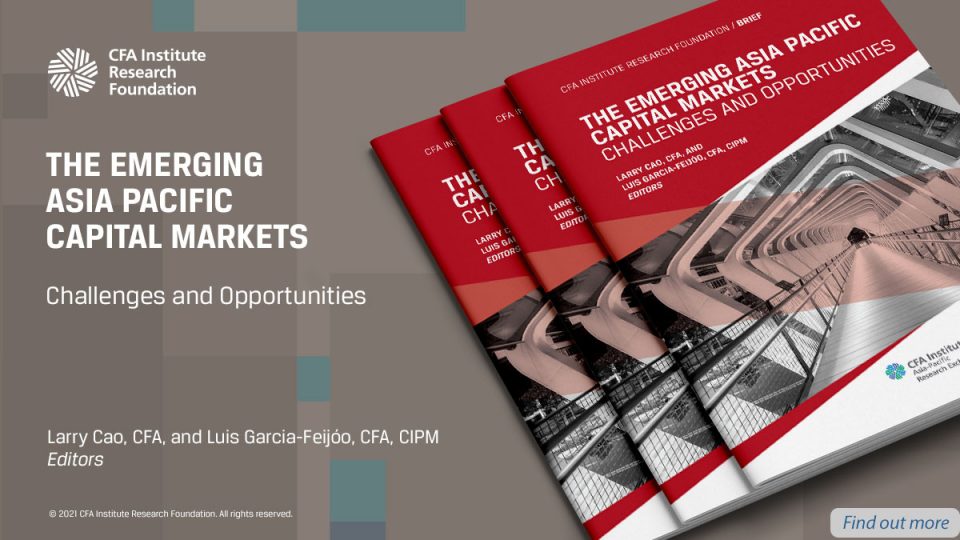
CFA Institute has published ‘The Emerging Asia Pacific Capital Markets: Challenges and Opportunities’. The report, compiled by Larry Cao and Luis Garcia-Feijóo, presents perspectives from local authors on the financial history, current status and outlook for 11 countries. Their insights should be particularly valuable for prospective investors.
Many have argued that the 21st century will be the Asian Century. And yet many capital markets in Asia-Pacific, particularly emerging markets, remain a mystery to much of the outside world.
The MSCI Emerging Markets Asia Index, launched at the beginning of the century, today includes nine markets. Of those, the relatively large and liquid capital markets of China (A shares), South Korea and Taiwan are better known globally because of the international success of local tech giants.
The report from CFA Institute covers the remaining six markets – India, Indonesia, Malaysia, Pakistan, the Philippines and Thailand – as well as five up-and-coming markets: Bangladesh, Cambodia, Mongolia, Sri Lanka and Vietnam.
Influence of history and importance of maturity
Countries such as India, Malaysia, Pakistan, the Philippines and Sri Lanka inherited a legal system influenced by the British system. Some even had exchanges set up centuries ago. Because of their history, their capital markets are more consistent with expectations formed from investing in the UK or US markets.
In contrast, Mongolia and Vietnam were part of the Soviet area of influence after World War II. Their regulatory systems are now in transition toward Western standards.
When investing in emerging and frontier markets, market maturity is an important factor to consider. More mature markets offer increased levels of information disclosure and tend to experience fewer dramatic swings in prices. Where data is available, the authors report the share of institutional ownership in a market and other indicators of market maturity.
The concept of the Asian Century was not without controversy from the beginning. Whether you are a believer or a sceptic, we hope that CFA Institute’s country profiles will help you identify opportunities and navigate risks.
Here we focus on India, Indonesia and Pakistan – three of the five largest countries in the world in terms of their population size – but you can access the full report here.
India
Indian capital markets have experienced a radical structural transformation since India opened its economy to the world in the 1990s.
Today the country, with a population estimated at 1.37 billion, boasts two of the world’s largest stock exchanges—NSE (National Stock Exchange of India) and BSE (formerly Bombay Stock Exchange)—and is considered one of Asia’s most preferred investment destinations for international capital, as evidenced by continued growth in foreign investment. In addition, the asset management industry has seen major growth, with increasing interest from domestic retail investors.
The country’s fixed-income and commodity markets are still shallow, with fewer incentives for market participants. Moreover, the exchange-traded fund industry is still in its infancy when it comes to investor awareness and market structure.
The principal capital market regulator, the Securities and Exchange Board of India, has taken a series of steps to not only protect investors but also to foster innovation and entrepreneurship in capital markets.
Furthermore, India has a young population, a fast-growing economy and widespread access to the internet. But in order for markets to achieve their potential, stakeholders need to come together and take steps that can remove bottlenecks and ensure that the huge amount of savings in the economy is harnessed. Regulations need to become precise and clear, and red tape eased, to fully reap the benefits of the demographic dividend.
Indonesia
Indonesia is one of the promising markets in Asia, as a country with the largest GDP in the Association of Southeast Asian Nations (ASEAN)—nominal GDP of $1.12 trillion (about £794bn) in 2019. Besides that, Indonesia has a population of about 267 million, the highest in ASEAN.
In 2007, Surabaya Stock Exchange merged with Jakarta Stock Exchange to become the Indonesia Stock Exchange (IDX). IDX continues to reform and advance the country’s capital markets, supporting systems, facilities and infrastructure, including the development of digital technology.
Over the years, the domestic stock market has grown tremendously and the regulatory environment has improved. For example, the number of listed companies on IDX increased to 668 in 2019 from 398 in 2009. On average, IDX has listed 30 new companies per year, and the amount is on an upwards trend.
Various outreach programmes have been implemented to attract issuers and investors. Major programmes include: the development of Islamic capital market products; the development of another listing board including small-and medium-size companies; simplification of the going public and listing process; and e-voting.
Pakistan
Following liberalisation measures in the 1990s, Pakistan’s stock market has modernised its operational architecture.
The country offers attractive valuations relative to other emerging markets plus an economy driven by strong domestic consumption.
Investing in Pakistan offers access to the fifth-largest population in the world (about 220 million people) and the country’s resilient domestic consumption stands out in a global economy affected by Covid-19.
The benchmark Karachi Stock Exchange KSE-100 is one of the most attractively valued among emerging markets indices and top-tier Pakistani companies are regularly held up as some of the best in the region on profitability and investor relations.
The Pakistan Stock Exchange (PSX)’s operational architecture allows for electronic trading, clearing and settlement, including that of corporate debt instruments and government securities.
The PSX was formed after the merger of Karachi, Lahore and Islamabad bourses, and today is majority owned by a consortium of Chinese exchanges. This has started to influence the market, judging by the recent acquisition of a new Chinese trading platform and a push on innovation.
In 2020 on the PSX, despite the challenges posed by the pandemic, IPOs were oversubscribed, exchange-traded funds were launched for the first time, and the trading regime saw the introduction of index halts and wider circuit breakers.
If our summary has whetted your appetite, click for more on India, Indonesia and Pakistan; and explore the further eight countries in the report: Bangladesh, Cambodia, Malaysia, Mongolia, Philippines, Sri Lanka, Thailand and Vietnam.
Authors:
India
Rajendra Kalur, CFA
Shwetabh Sameer, CFA, CIPM
Indonesia
Ignatius Denny Wicaksono, CFA
Pakistan
Mohammad Shoaib, CFA
Raza Jafri, CFA
Sateesh Balani, CFA
Image credit: ©Getty Images / KSChong