
Economists raise fears over Rishi Sunak’s new job support plan

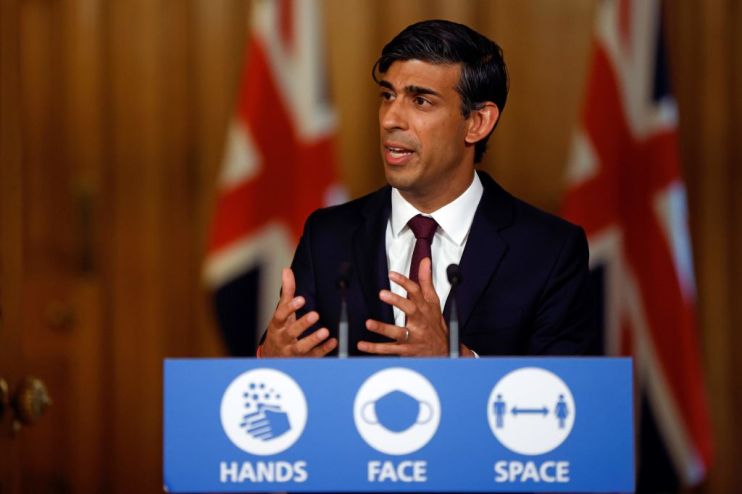
Economists this afternoon raised concerns that Rishi Sunak’s new support measures could lead to many workers losing their jobs as they do not encourage firms to keep employees on.
The centrepiece of the chancellor’s scheme is a new “Job Support Scheme”, which will replace the existing furlough initiative.
Under the plan, the government will support “viable jobs” by topping up employees’ wages, although the scheme is far less generous than its predecessor.
Although workers will receive a minimum of 78 per cent of their wages, the government will only pay 22 per cent of this. Under the furlough scheme, the government was paying 80 per cent.
Paul Johnson, director of the Institute for Fiscal Studies, said: “[Sunak] is trying to plot a difficult path between supporting viable jobs while not keeping people in jobs that will not be there once we emerge from the crisis.
“With employers now having to pay at least 55 per cent of the normal wages of their employees it is clear that many jobs will be lost over the coming months.”
The IoD’s director-general Jonathan Geldart said that though the schemes would bring businesses “some relief”, it was “not yet clear how much the Job Support Scheme will help hard-pressed firms hold onto staff”.
Aidan Shilson-Thomas, senior researcher at think tank Reform, said the new scheme had a “in-built disincentive for employers”.
“Why would an employer, struggling to stay afloat and uncertain when the economic tide will change, pay this additional cost? Many may opt for simply reducing workers’ hours without top up or proceeding with redundancy”, he said.
As a result, said Howard Archer, chief economic advisor to the EY Item Club, there are likely to be a large number of redundancies at businesses which are not viable when the furlough scheme ends.
“Today’s announcement is undoubtedly an important intervention by the Chancellor and is likely to save a substantial number of jobs”, Archer said.
“However, there are still likely to be job losses when the furlough scheme ends in October, albeit in companies that were not viable.
“The chancellor’s intervention may also do little to support jobs at companies which may face short-term challenges, even if their longer-term prospects are more favourable.”
Focus on jobs ‘with a future’ right
However, business groups welcomed the plan, saying that supporting “viable” jobs was the right approach to take.
Dame Carolyn Fairbairn, CBI director-general, said that it was right for the Treasury to focus on jobs “with a future”.
“These bold steps from the Treasury will save hundreds of thousands of viable jobs this winter. It is right to target help on jobs with a future, but can only be part-time while demand remains flat. This is how skills and jobs can be preserved to enable a fast recovery”, she said.
BCC director general Adam Marshall said: “The measures announced by the chancellor will give business and the economy an important shot in the arm.
“The new wage support scheme will help many companies hold on to valued employees after furlough ends, and the extension of business lending schemes and tax forbearance will lessen the immediate pressure on cash flow for many affected firms.”
Kevin Ellis, chairman and senior partner at PwC, said the new policy marked a shift away from the rescue package announced back in March.
The new schemes are designed to “consolidate the recovery”, he said.
Economy cannot ‘hibernate’ over the winter
Although welcoming the new support, Canada Corporation Policy Chair Catherine McGuinness said that it was crucial for the government to find a way to get people back to their places of work.
“Alongside its economic response, we hope that the government will enable a safe, secure and flexible return to the workplace as soon as possible.
“A huge amount of work has been done to deliver COVID-secure offices and restore confidence in the public transport network. Getting employees back to the workplace safely is essential to foster innovation, support mental health and deliver the footfall needed for the hospitality and retail sectors.
“The virus is not going to go away quickly so we need to find a way of living with it. Hibernating through the winter is not an option for our economy.”