
Economic performance under Labour and Conservative governments: a reckoning

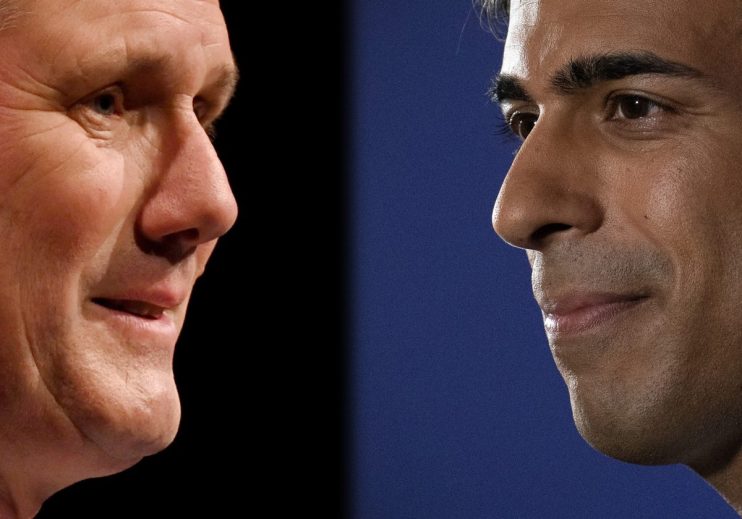
Voter apathy over the upcoming election is rational – history suggests the economic outcome will be broadly the same regardless of whether Labour or the Conservatives form the next government, says Paul Ormerod
The election campaign has kicked off and already the air is thick with promises and counter-promises.
Despite all the efforts of politicians to grab the attention of voters, a notable feature of this election seems to be that many people are not enthused by either of the main parties. Common refrains are “they are all the same” or, less generously, “they are just as bad as each other”.
Perhaps surprisingly for some, there is a strong element of rationality in the view that the economic outcome will be broadly the same regardless of whether the Conservatives or Labour form the government.
The evidence of economic performance since the Second World War supports this opinion.
By 1948, the workings of a normal peacetime economy had more or less resumed. The massive task, for example, of demobilising the millions of people in the armed forces had effectively been carried out.
So we can look at the data over 75 years, from 1948 to 2023, and observe the economic record of governments over that period. The Tories have been in power for 47 of those years and Labour for 28.
The annual rate of growth of GDP is the key determinant of the increase in living standards. On this basis, the record of the two parties is effectively identical. Growth averaged 2.2 per under Labour and 2.5 per cent under the Conservatives.
The raw numbers suggest that the Tories have the edge on inflation, averaging 4.1 per cent a year under them and 5.5 per cent under Labour.
But drilling down, an adjustment is needed in Labour’s favour. Edward Heath’s Conservative government lost office in February 1974. But it had created the inflationary storm which burst on the country that year and into 1975.
The Chancellor, Anthony Barber, had expanded the money supply massively. The government has introduced a system under which, if inflation rose above a certain level, workers did not have to wait for their annual pay rise. They got one every month. On top of this, in the winter of 1973/74 oil prices quadrupled.
So it was not Labour’s fault that inflation soared to 15.8 per cent in 1974 and 21 per cent in 1975. It did fall back into double figures, though not because of positive actions by the government. Sharply rising unemployment and a recession curbed both wage demands and price increases.
The similarity between the economic outcomes under the two parties extends into the record of what ought to be the most important issue of the campaign.
Since 1997, the year in which Tony Blair was first elected, there has been no productivity growth at all in the public sector. Indeed, on the latest Office for National Statistics data there has been a slight fall over this period. Over this period, Labour and the Conservatives have been in power for effectively the same amount of time.
In contrast, the efficiency of the private sector has increased by 27 percent .
Even a very modest improvement in efficiency of just 0.5 per cent each year in the public sector over the past quarter of a century would have led to additional £70bn now being available for spending or tax cuts.
To be fair, one leading politician is focused on this. Wes Streeting, Labour’s health spokesperson, has made noises which are strongly critical of the performance of the NHS.
Streeting has stated that people are voting on health with their feet. The demand for private health care is booming as the inefficiencies of the NHS become more and more apparent.
Whether he can translate his words into deeds remains to be seen. But others should copy Streeting’s example and make the efficiency of the public sector into a major issue in the election. History will be judging them for it.
Paul Ormerod is an economist at Volterra Partners LLP, an Honorary Professor at the Alliance Business School at the University of Manchester and author of Against the Grain: Insights of an Economic Contrarian, published by the IEA in conjunction with City PM