
ECB stimulus measures underwhelms investors disappointed by lack of rate cut

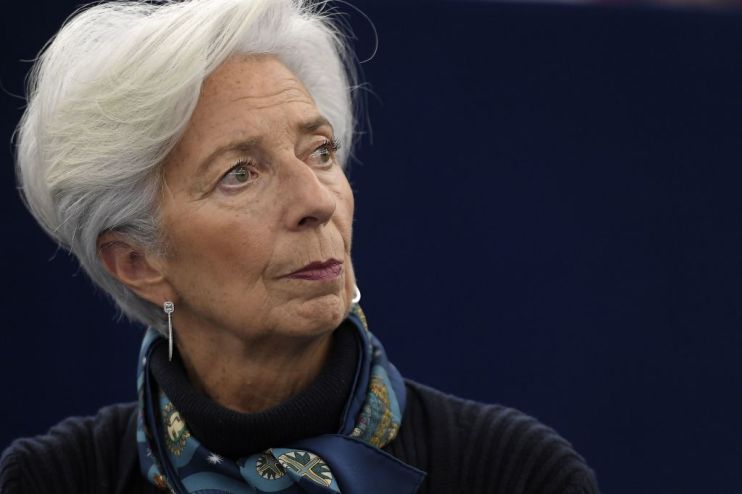
The European Central Bank has unveiled a fresh stimulus package to help fight the economic impact of the coronavirus pandemic , but markets were left dismayed as the ECB unexpectedly stopped short of an interest rate cut.
With millions of European citizens under lockdown and equities across the continent in freefall, the ECB had come under sustained pressure to roll out what little was left in its policy arsenal.
The central bank said it would give businesses more ultra-cheap loans, increase asset purchases, and provide banks with capital relief to combat the economic shock of the outbreak, but would hold interest rates at their current record low of 0.5 per cent.
Read more: Coronavirus: US travel ban decimates airline stocks
The ECB described the stimulus package, Christine Lagarde’s first since taking over as head of the ECB in November, as a “comprehensive package of monetary policy measures”.
Coronavirus to ‘a major shock’ for eurozone growth
Speaking at a press conference following the announcement of the stimulus, Lagarde said the coronavirus represented “a major shock” to the eurozone’s growth prospects.
“I’ll tell you what I’m worried about: it would be the complacency and the slow motion process that would be demonstrated by the fiscal authorities of the euro area in particular,” Lagarde told reporters.
“I don’t think that anybody should expect any central bank to be the line of first response. It’s fiscal first and foremost,” she added.
European political leaders are working on a fiscal response to the pandemic, with many hoping for an announcement following a meeting of top finance officials in Brussels on Monday.
Central bankers around the world are fighting to mitigate the economic impact of Covid-19, with the Bank of England and Federal Reserve both making emergency rate cuts of 50 basis points.
The Bank of England has also launched a package of targeted measures to combat the outbreak, which was declared a global pandemic by the World Health Organisation yesterday.
But with interest rates already in negative territory at a record low of negative 0.5 per cent, the ECB had little room to manoeuvre on rates.
However the market had still been expecting a cut of 10 basis points, which would have plunged rates further into negative territory to a fresh record low.
Targeted lending for small businesses among measures
As part of the stimulus measures, the ECB will provide eurozone banks with loans at rates as low as negative 0.75 per cent, which essentially functions as a rebate as it is below the eurozone’s current deposit rate of negative 0.5 per cent.
The central bank will also increase bond purchases by €120bn this year, with an emphasis on corporate debt.
Seema Shah, chief strategist at Principal Global Investors, described the ECB’s decision to introduce a new targeted lending operation at a rate below the deposit rate as “a powerful move”.
“It is paying banks to borrow from the ECB and, in turn, encouraging banks to pay businesses to borrow from them,” she explained, adding that this “should strongly encourage banks to lend to SMEs, the part of the economy which is most vulnerable to the Covid-19 shock.”
Moritz Sterzinger, Director at Chatham Financial, said that while the ECB’s decision to hold rates has disappointed investors who had priced in a 10 basis point cut, such a move may not have had the desired effect.
“Given the current level of euro interest rates, it is indeed highly doubtful whether any further reductions in the ECB’s deposit rate would provide any meaningful stimulus, particularly in the current situation where weak demand is not the result of high borrowing costs,” he said.
Lagarde’s slip up rattles investors
Lagarde said this afternoon that the ECB was “not here to close” sovereign spreads which have increased sharply in recent weeks, particularly in Italy, the epicentre of the outbreak in Europe and regarded as one of the eurozone’s most vulnerable borrowers.
The entirety of Italy has been placed under lockdown in the most extreme containment measures yet announced in Europe. All shops except food stores and pharmacies in Italy have closed, as coronavirus cases and deaths in the country continue to mount.
Lagarde’s comments sent yields on 10-year Italian government bonds shooting up, with the cost of borrowing jumping by the highest amount ever in a single day.
The closely watched gap between Italian and German 10-year bond yields, effectively the risk premium the latter pays on its debt – hit its widest level since June.
Nomura forex strategist Jordan Rochester said that while Lagarde’s comment “might be true” in terms of the ECB’s perception of its mandate, the remark was “ not what you say when markets are selling off on a day like today”
European equities pummelled again
European equities had already been shaken by US President Donald Trump’s surprise announcement yesterday that he would suspend travel between Europe and the US.
Investors were unimpressed by the ECB’s performance, with European stocks plunging further into the red following the announcement.
The FTSE 100 closed 10.87 per cent down, the index’s second largest drop ever. Germany’s Dax and France’s CAC 40 shed over 12 per cent apiece.
Spain’s Ibex 35 ended the day down over 14 per cent, its largest ever daily loss.
Read more: Lloyd’s of London announces coronavirus shutdown simulation
Mohammed Kazmi, a UBP macro strategist, said the ECB’s messaging “was a disappointment for the market and risk has been unable to stabilise as a result”.
“Lagarde’s focus on the need for fiscal policy has not provided much comfort given the often-slow moving pace of government authorities,” he added.