Skip to content
City PM
  • Germany
  • France
  • Europe
  • Markets
  • Business
  • Opinion
  • DE
  • Germany
  • France
  • Europe
  • Markets
  • Business
  • Opinion
  • DE
Tuesday 05 May 2015 4:45 am

Drug companies are producing more new cancer drugs than ever before – but can countries actually afford them?

By: Sarah Spickernell

Add as a preferred source on Google

The world faces a cancer medication conundrum. On the one hand, the ageing population means we need more effective treatments for the disease, but on the other hand these can cost so much to create that we can't use them. 

The IMS Institute for Healthcare Informatics estimates that last year, global spend on cancer drugs reached $100bn (£66m) for the first time ever, which amounts to $99 per head. This was up from $71 per head in 2010, and marks a 10.3 per cent increase in spend compared to 2013.
 
Why the sudden surge in spending? Pharmaceutical giants like AstraZeneca, Roche and Merck & Co are all investing in a new kind of cancer treatment that work by harnessing the body's own immune system to fight tumours. 
 
These drugs are highly effective, and have been heralded by experts as the biggest step forward in cancer treatment in decades. “New therapeutic classes and combination therapies will change the cancer landscape over the next several years,” the US analytics firm said in its report. 
 
But such progress comes at a price – some of those launched in the US in recent months have reached costs of around $150,000 per year, and the result is that many of them will never be used to treat patients because public health services won't be able to afford them. 
 
Between 2010 and 2014, 45 new cancer drugs were released by pharmaceutical companies, but in no country across the world have patients had access to all of them. The broadest access was seen in the US, Germany and the UK, while very few were available in Japan, Spain and South Korea. 
 
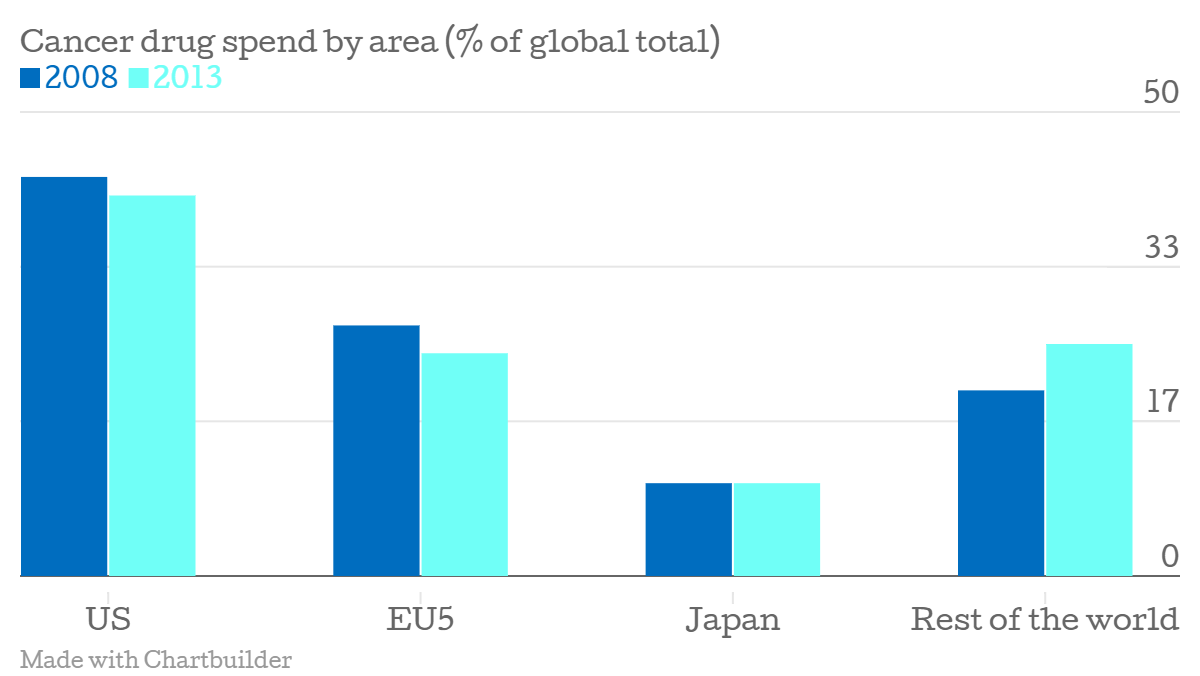
This falls in line with national spend on cancer drugs as a proportion of the global total, with the US  coming first, with 42.2 per cent, followed by the five biggest economies in Europe – Germany, France, Britain, Spain and Italy (EU5). 
UK losing out

In the case of the UK, a Cancer Drugs Fund has been set up to allow greater spend on treatments for the disease than would be allowed under normal NHS conditions, but it is still unable to purchase many of the new medicines that come to market. 
 
In fact, its ability to invest in new treatments is diminishing – earlier this year, the government earmarked 16 cancer drugs for ejection from the fund, on the grounds that they were not cost-effective enough to warrant provision on the NHS. 
 
This reflects a shifting global trend, which can be seen in the graph above – over the five-year period, the dominant forces in drug manufacture have been losing out to the rest of the world. 

Share this article

  • Facebook
  • X
  • LinkedIn
  • WhatsApp
  • Email

Similarly tagged content:

Sections

  • News

Categories

  • Tech

Trending Articles

  • Exclusive: Big Four giant KPMG to cut more jobs

  • Music tycoon Simon Cowell sued by prominent City lawyer

  • The former African gold miner taking on the billionaire Issa brothers

  • Tesco ‘in talks’ to exit eastern Europe

  • Easyjet agrees to £5.7bn Apollo takeover

More from City PM

  • GSK shares slip after buying US cancer treatment firm Nuvalent for $10.6bn

    Pharma
    GSK logo displayed prominently, signifying the companys presence and relevance in the business and healthcare sectors.
  • Patent cliff fuels Novartis’ $1.5bn swoop for London biotech

    Healthcare
    Hikma produces generic drugs
  • People named Mark called upon to raise money at London charity golf day

    Sport Business
    Breaking news concept with digital globe and newspaper headlines on a blue background, representing global journalism.
  • Leo Cancer Care Raises $65M Series D to Scale Its Integrated Upright Cancer Care Platform

    Business Wire
  • Anocca has Dosed First Patients with Precision TCR-T Cell Therapy Targeting Mutant KRAS in Pancreatic Cancer

    Business Wire
  • Araris Biotech AG and Taiho Oncology Announce Dosing of First Patient in Phase 1 Trial of ARC-02, a Novel ADC for the Treatment of Non-Hodgkin Lymphoma

    Business Wire
  • Terry Smith dubs weight-loss giant Novo Nordisk ‘investment disaster’

    Investing
    Terry Smith, founder of Fundsmith, speaking at a business conference, wearing a suit and tie, with a focused expression.
  • IMU Biosciences Selects Waters to Advance Breakthrough AI Immune Mapping Platform to Transform Early Diagnosis, Monitoring, and Precision Medicine

    Business Wire

City PM — European politics, business and analysis.

Europe

  • Germany
  • France
  • Europe
  • UK & Ireland

Topics

  • Business
  • Markets
  • AI
  • Technology
  • Opinion
  • Energy

More

  • Politics
  • Economics
  • Fintech
  • Legal
  • Sport
  • Life

Company

  • About City PM
  • Editorial Policy
  • Corrections
  • Contact
  • Terms of Use
  • Privacy Policy
  • Cookie Policy
© 2026 City PM · Published by CityPM Media, Bahnhofstrasse 65, 8001 Zürich, Switzerland
About · Editorial Policy · Corrections · Contact · Privacy · Facebook