Skip to content
City PM
  • Germany
  • France
  • Europe
  • Markets
  • Business
  • Opinion
  • Germany
  • France
  • Europe
  • Markets
  • Business
  • Opinion
Friday 21 February 2025 4:26 pm

Debt brake the central focus for investors ahead of German election

By: Chris Dorrell

Add as a preferred source on Google
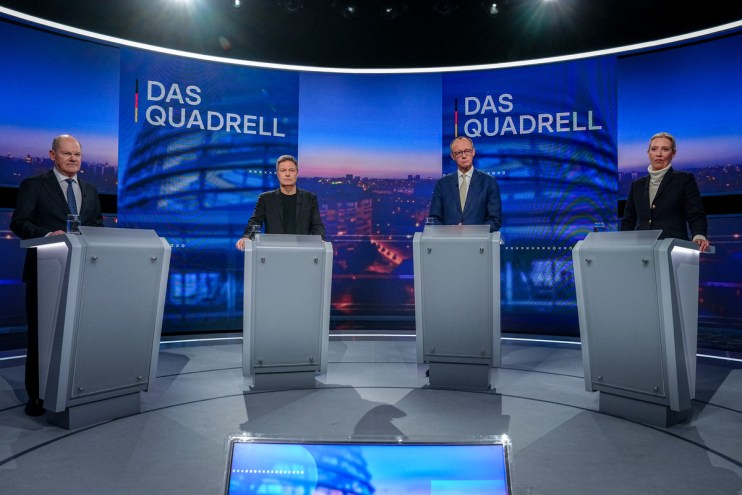
(L-R) German Chancellor Olaf Scholz, top candidate for chancellor of Germany's Social Democratic SPD party, Green Party's main candidate and German Minister of Economics and Climate Protection Robert Habeck, Friedrich Merz, main candidate and chairman of the Christian Democratic Union (CDU), and co-leader and main candidate of the far-right Alternative for Germany (AfD) party Alice Weidel take part in a TV debate in Berlin on February 16, 2025, ahead of the parliamentary elections due to take place on February 23, 2025. (Photo by Kay Nietfeld / POOL / AFP) (Photo by KAY NIETFELD/POOL/AFP via Getty Images)

The German elections will take place this weekend amid a dire economic backdrop in Europe’s largest economy.

The German economy has shrunk in each of the past two years, meaning German GDP is now slightly smaller than it was pre-pandemic. In contrast the wider euro area is 4.7 per cent larger than it was before the pandemic.

Consensus expectations for GDP growth in 2025 stand at just 0.3 per cent, down from 1.2 per cent in August. Analysts at Nomura said “Germany has continuously flirted with recession since the pandemic”.

Given this woeful performance, it is no surprise the economy has been a central part of the German election campaign.

Debt brake

For most investors, the crucial question this weekend is whether the election will deliver a majority to reform Germany’s restrictive ‘debt brake’, which puts stringent limits on government spending.

The debt brake has been in place since the financial crisis, and limits the budget deficit to 0.35 per cent of GDP each year.

In effect this makes significant public investment impossible, which is a particular problem given the succession of shocks which have hit the German economy in recent years.

A growing chorus of economists and politicians – including Angela Merkel – think that reforming the debt brake is vital for reinvigorating the German economy.

According to the German Economic Institute, addressing the various challenges facing the German economy – like improving infrastructure, accelerating digitisation and increased defence spending – will cost around €600bn by 2030.

“It is impossible to see any substantial overhaul happening without higher public spending,” Carsten Brzeski, global head of macro at ING said.

“Just to make up for the underinvestment of the last decade, Germany would need to invest around 1.5 per cent of GDP every year for the next 10 years,” he said.

But any constitutional reforms require a two-thirds majority in the Budestag, which is where things start getting complicated.

The centre-right CDU, under the leadership of Friedrich Merz, is projected to emerge as the largest party, and currently polls at around 30 per cent.

Although the CDU promised to maintain the debt brake in its election manifesto, Merz has since sounded more open to reforming the rule.

Read more

UK economy falters as deeper damage to growth to come

Rachel Reeves speaking at an IOD event.

“I have always said that you can discuss this, but definitely not at first,” Merz said in televised debates last week. Door firmly ajar.

The far-right AfD – which is anti-reform – trails the CDU on 21 per cent, with the ruling SPD on 16 per cent and the Greens on 13 per cent. Both the SPD and the Greens support debt brake reform.

A Grand Coalition between the CDU and the SPD is widely seen as the most likely outcome, since all of the major parties have ruled out going into coalition with the AfD.

But it will likely take months for a coalition to form. In the meantime the best indicator for the likelihood of reform is the performance of Germany’s smaller parties.

Small parties key

Parties need to garner five per cent of the vote to enter the Bundestag, which means very small changes in vote share can have big impacts on wider parliamentary arithmetic.

There are a handful of parties hovering around five per cent, including the left-wing Die Linke (pro-reform), the politically-confused BSW (anti-reform), and the free-market FPD (anti-reform).

The latest seat projections suggested that around 29 per cent of the seats would go to parties opposed to debt brake reform, suggesting there’s hope for fiscal reform.

But this does not include any dissenters from the CDU, and there’s likely to be a few. It will be tight.

“Put simply if one of the fringe parties enters parliament it‘s likely that the centrist parties will still have a two-thirds majority that could allow them to change the debt break if they agree to,” Jim Reid, Deutsche Bank’s head of research said.

“If two enter they are unlikely to have a two-thirds majority and the subsequent horse trading could prevent meaningful reform,” he said.

Either way, it is worth remembering that Merz is not a huge supporter of reform, which will limit the extent to which he’s willing to adjust the rules.

The rest of his platform centres on deregulation, corporate tax cuts and tax cuts for richer households, which does not cohere that neatly with big public investment programmes.

“The scale of any reform is likely to be quite modest,” analysts at Capital Economists said.

Read more

Are we about to see one of the biggest shifts in monetary policy since the financial crisis?

Share this article

  • Facebook
  • X
  • LinkedIn
  • WhatsApp
  • Email

Similarly tagged content:

Sections

  • News

Categories

  • Economics

People & Organisations

  • debt brake
  • economics
  • Friedrich Merz
  • German elections
  • Germany
  • Olaf Scholz

Trending Articles

  • Burnham tax plans spark investor rush to bank capital gains

  • Brewdog chief executive quits after only one year

  • Nothing fails to file accounts months after dissolution threat

  • UK ‘no longer a serious place’ says Hedge fund boss after losing £200m tax battle

  • Cruyff turn: Starmer allows pubs to stay open for England World Cup game

More from City PM

  • UK economy falters as deeper damage to growth to come

    Economics
    Rachel Reeves speaking at an IOD event.
  • Are we about to see one of the biggest shifts in monetary policy since the financial crisis?

    Opinion
  • Volkswagen’s China crunch deepens as Europe’s biggest carmaker weighs 100,000 job cuts

    Transport & Infrastructure
    Volkswagen is suffering from high costs, fierce Asian competition and a prolonged bitter conflict with unions over plant closures.
  • The next Prime Minister can change the conversation on the fiscal rules

    Opinion
    Treasury Department building with government bonds signage, representing financial management and bond issuance responsibi...
  • Frasers bid for Hugo Boss ‘more compelling’ amid turnaround

    Retail
    Mike Ashley, founder of Frasers Group Plc. Photographer: Chris J. Ratcliffe/Bloomberg via Getty Images
  • The Debate: Should the resignation of the Prime Minister trigger a general election?

    Opinion
    Keir Starmer announces resignation at podium, addressing media with serious expression against a backdrop of political ban...
  • German FA HQ raided by police in bribery probe days after shock World Cup exit

    Sport Business
    Getty Images logo on a digital screen with a blurred background, representing stock photography and visual media services.
  • OECD: Growth to remain below one per cent as UK economy struggles with unemployment

    Economics
    Sir Keir Starmer and Rachel Reeves discussing policy at a press conference, emphasizing Labours economic strategy

City PM — European politics, business and analysis.

Europe

  • Germany
  • France
  • Europe
  • UK & Ireland

Topics

  • Business
  • Markets
  • AI
  • Technology
  • Opinion
  • Energy

More

  • Politics
  • Economics
  • Fintech
  • Legal
  • Sport
  • Life

Company

  • About City PM
  • Editorial Policy
  • Corrections
  • Contact
  • Terms of Use
  • Privacy Policy
  • Cookie Policy
© 2026 City PM · Published by CityPM Media, Bahnhofstrasse 65, 8001 Zürich, Switzerland
About · Editorial Policy · Corrections · Contact · Privacy