
Day by day, Donald Trump is reshaping America. We travel the west coast from Canada to Mexico speaking to people about their hopes and fears, and how their lives are changing


The Seattle skyline, with the iconic Space Needle against the backdrop of Mt Rainier, may be familiar from TV series including Frasier and Grey’s Anatomy, but it’s the city’s music scene that sent ripples across the world, through Pearl Jam, Nirvana and Jimi Hendrix.
“The music scene helped build Seattle’s liberal values,” says Nick, a guide for the Savour Seattle food tour of Pike’s Place Market. Today, Washington state allows same-sex marriage and recreational marijuana use. So long as you leave other people alone, you can pretty much choose to live how you like here. The multi-level Pike’s Place Market has been here since 1907. Most of the produce – cherries, blueberries, jams, wine, cheese – is made less than an hour from Seattle, on the other side of the mountains. The politics of the producers, however, couldn’t be more different from their metropolitan consumers.
The Cascade Mountain range runs north-to-south through Washington. To the west are urbanised, coastal regions like Seattle. To the east are the rural farmlands that supply Pike’s Place Market with its fruit and veg. But as well as being a geographical marker, the mountains are a political divide.
“Politically, I’m a libertarian, not a liberal,” says Jon, who is from the renowned wine-producing region of Walla-Walla, east of the mountains, where you can walk to 30 different wine-tasting rooms from Main Street. “I don’t want the government interfering in my life; we need fewer laws and less regulation, not more laws against offending people or redistribution of wealth.”
You can see the same rural-urban split in Oregon, the next state south of Washington. In the 19th century, pioneers from the Midwest staked out land claims across the state. Far from government protection and support, they developed a sense of self-sufficiency, which their descendants have inherited.
In the town of Elkton (population 204), fishermen and hunters are the bedrock of the community, so environmental protection and sustainability are paramount.
“We want to keep this place clean and beautiful,” says the waitress in the town’s only restaurant. “Our livelihood depends on it, so we have to look after it. But people here choose to protect the environment. They don’t need to be told what to do by the government.”
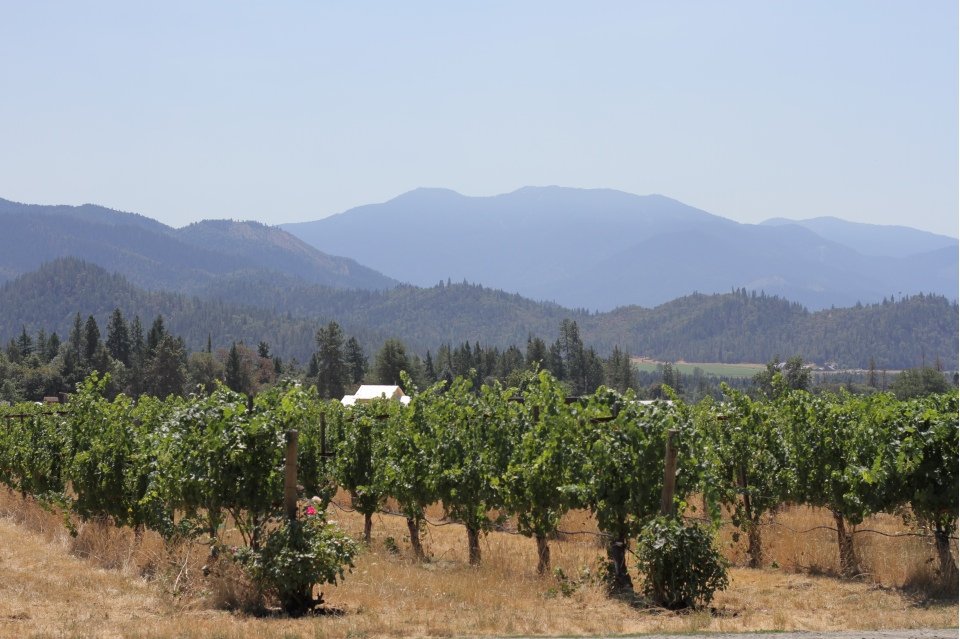 Vineyards in Oregon
In the cafe car park, a group of lads were loading up a car with hunting gear. I say car, but it was one of those oversized flat-beds that make Land Rovers look small; on the bumper was a large Trump-Pence sticker. I got chatting to the driver, a polite young man who offered me some beef jerky. They were students from Salem, Oregon’s state capital.
“Salem’s full of hippies smoking dope,” he said with a laugh. “So it’s good to get outside on the weekends. Sure, I disagree with them on politics, but we don’t need to argue. And I don’t agree with everything Trump says, but I preferred him to Clinton.”
Portland
Salem may be the capital, but Portland is the largest city in Oregon. It was built with small city blocks to give it more corner stores to attract merchants. This makes Portland “human-sized” and fun to explore, full of boutique coffee roasters, restaurants and microbreweries. Portland was one of the cities that opposed Trump’s travel ban, and it’s become a byword for progressive ideology, with initiatives like the Refugees Welcome Farm Supper raising money for refugees, who also come to the dinner as a way of integrating into the community.
“We use ingredients from the farm to make dishes native to the refugees’ countries,” says Stacey Givens, the chef behind the initiative, “It builds a human link between new arrivals and locals, helping them whilst introducing Portlanders to new cuisine.”
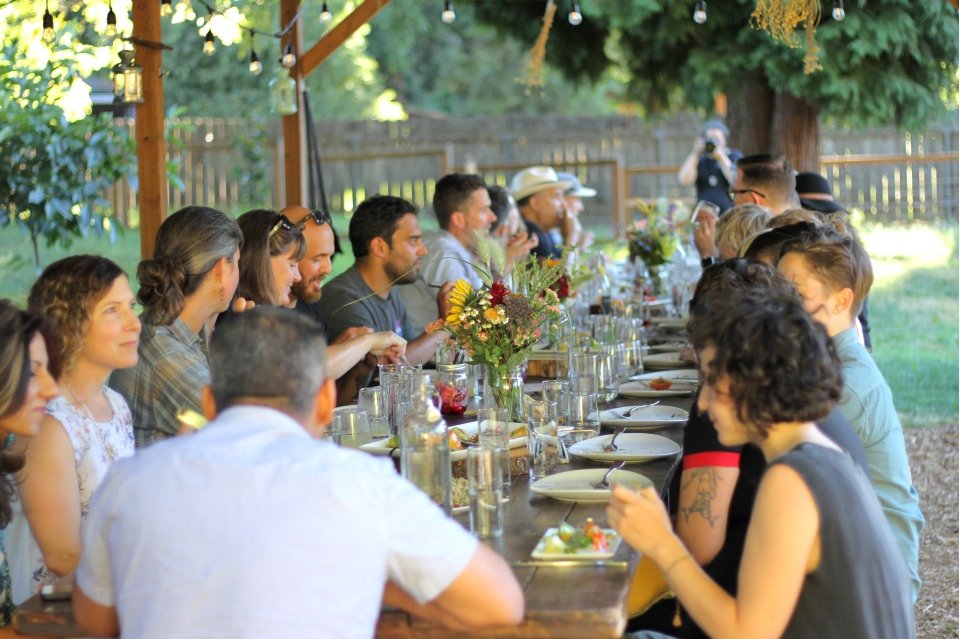 The Refugees Welcome supper club in Portland raises money for those who need it
The family being supported this evening had escaped from Iraq with their young children, and 10 per cent of the event’s proceeds were being used to help them settle in. In the warm evening air, I sat at a long table next to strangers who quickly became friends, and tucked into lamb kebab, baba ganoush, hummus and fresh salads.
My dining neighbour, Paula, was a designer in nearby Beaverton. “Immigrants built America,” she says, “And Trump is constantly attacking them. Even if no actual policy appears, what he says is poisonous. There was an attack by a neo-Nazi on a Muslim woman in Portland last year. In Portland! One way to oppose him is to support initiatives like this supper club. Making refugees welcome is as important as financial help.”
San Francisco
A further nine hours south, San Francisco is the historic heart of the hippy movement, known for gay rights, student protests and radical thinking. In the 2016 Presidential election, Hillary Clinton won nearly 10 times as many votes here as Trump. But his policies are popular with two very different groups.
“Many people in tech lean towards Trump,” says Ben, a software engineer from Nottingham, now working in Silicon Valley. “Sure, they start out as young and disruptive, but once they have money, they quickly start to dislike taxes. And they hate regulation that reigns in their actions.
“Then there’s those who’ve been left behind, the locals who saw outsiders move to San Francisco and make fortunes in tech. They’ve seen rent and house prices skyrocket, but their opportunities and wages stagnate. Trump has pitched directly to those people with his ‘Make America Great Again’ thing.
“Don’t get me wrong,” Ben says. “San Francisco isn’t about to become a bastion of Trump-dom. But seeing those people moving towards Trump makes me understand how he appeals to people all across America.”
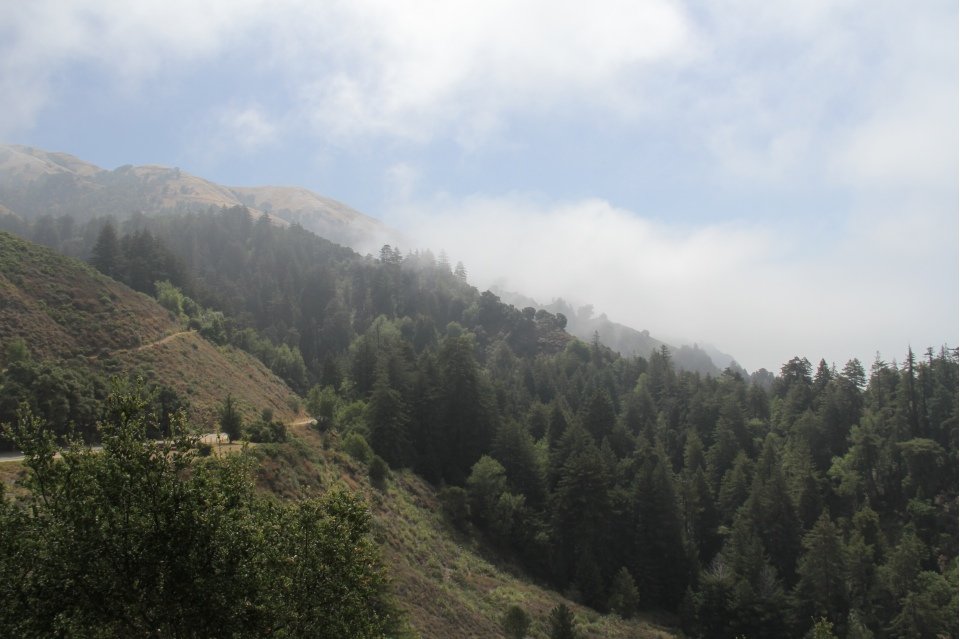 Big Sur, California
South of San Francisco is Big Sur, a stretch of coast described by landscape painter Francis McComas as “the greatest meeting of land and water anywhere on Earth.” In the 1960s, two Stanford graduates bought land here next to natural hot springs and set up the Esalen Institute, so people could come to share ideas on human potential and Eastern philosophy.
Esalen became the centre of the new age movement, with the philosopher Aldous Huxley and LSD pioneer Timothy Leary both teaching there. In 1979, it started the “Cold War, Hot Tub” exchanges, bringing Soviet diplomats, including Boris Yeltsin, to meet American leaders, including President Bush. A recent exchange involved Israel and Syria.
In 2017, huge landslides either side of Big Sur made it a proper bubble from the outside world. The landslides cut the highway, leaving a mountain road through a military firing range as the only route in or out
“People round here don’t tend to talk politics,” says Jacob, who moved from New York to be a masseuse at Esalen. “It’s both anarchic and progressive. People want to get away from the duality of the outside world. Politics is only welcome if it’s peace talks in hot tubs.”
In 2017, huge landslides either side of Big Sur made it a proper bubble from the outside world. The landslides cut the highway, leaving a mountain road through a military firing range as the only route in or out. An estimated 75 per cent of the population left, but it created a new sense of positive localism.
“We went from 13,000 cars passing through a day to none!” says Jacob. “People set up basketball hoops on Highway 1 and rode horses to work. Others just couldn’t hack it and left.”
For a while, Big Sur returned to the 1950s enclave that appealed to Beat generation authors like Henry Miller and Jack Kerouac. “People get to Big Sur and it’s paradise,” said Miller. “Nothing needs to be changed externally, so it’s got to be changed internally.”
Sarah Bofenkamp is the guardian of the Big Sur Henry Miller library. “The distractions and politics of the outside world disappear here,” she says, “That can be hard because you have to face yourself, so people either leave, go mad or become a good neighbour. That’s the closest you get to politics in Big Sur.”
Salinas Valley
The highway landslide meant I had to drive inland to continue my journey South, via Highway 101 through the fertile Salinas Valley. It’s home to lettuce farms, vineyards and thousands of Mexican labourers who come to pick crops. Salinas was also the home of author John Steinbeck, who wrote movingly about the plight of economic migrants.
“Men of property were terrified [for] their property,” he wrote in his 1939 classic The Grapes of Wrath. “And the men of the towns and of the soft suburban country gathered to defend themselves: they reassured themselves that they were good and the intruders bad, as a man must do before he fights. In the souls of the people, the grapes of wrath are filling and growing heavy.”
Steinbeck was writing about the attitude towards “Okies”, migrants from the Oklahoma Dust Bowl, who fled west for work, but Candidate Trump echoed those sentiments on the campaign trail, talking instead about Mexican labourers. In the Starbucks opposite the John Steinbeck Library, built in memory of the author, a Latina barista spoke to me with an American accent.
“Trump doesn’t know his history,” she said, “The Spanish built missions in Southern California in the 18th century, when it was part of Mexico. Latin people, including my family, were living here long before the US took it in 1848.” She gestured to the fruit stalls in the street, and the Mexican labourers buying their lunch from taco trucks. “Everything depends on them. Farms need them to pick fruit. Developers need them to build houses. Shops need them to spend their wages. If you stop the Mexicans coming here, everything stops.”
Los Angeles
My next stop was Los Angeles, which might be best known for its movie industry but is also home to a different type up star-hunter. The hills of nearby Pasadena are home to the Jet Propulsion Laboratories (JPL), NASA’s research and development division.
JPL actually precedes NASA by some 22 years, and has done more for space exploration than any organisation on Earth: since launching America’s first satellite in 1958, JPL spacecraft have made the Moon landings possible, visited every planet in the Solar System, and even found conditions suitable for life on Saturn’s moons.
 NASA's Jet Propulsion Laboratory in its heyday
A third of all of JPL probes actually look at Earth, monitoring carbon dioxide, sea level and ocean currents on our own planet. This data allows us to see the effects of human behaviour. But since Trump’s election, several climate science missions have been put on the chopping block.
“The President loves manned space exploration,” says one engineer, during our tour, He made it a national policy to return America to the Moon and put humans on Mars. But he has reduced funding for unmanned probes and Earth observation. “Men on Mars might be exciting, but climate change will destroy our cities and agriculture. We need to know what’s going on, and unmanned probes monitoring our planet are the way to do it. It’s not exciting, but it’s important.”
I ask if cutting the climate-monitoring missions has anything to do with Trump’s well-known denial of climate change. “A cynic might say that,” she replies, with a wry smile.
Heading back into LA, I drove through South Central and Compton. These districts became infamous in the 1980s and 90s for social unrest and gang violence. But as the home of rappers including Dr Dre, Ice T, The Game and Kendrick Lamar, they were also the crucible for West Coast hip-hop.
The Game’s stepfather, Hodari Sababu was a member of the infamous Bloods gang, and he now runs Hip Hop Hood Tours with his friend Steve, a member of the rival Crips gang. “I don’t do gang-banging these days,” Steve says, referring to the gang violence. “But that don’t mean I ain’t a Crip no more. The gang gave me belonging. I was 11 or 12 years old, hanging out with 40-year olds, drinking, smoking, selling drugs.”
So were the gangs… a good thing?
“Hell, no. Kids don’t have any opportunities now. Not for work, not for hobbies. We messed all that up. See, the public pools and the parks was where we did all the gang-banging. So the police had to shut them down.”
I ask Steve whether he thinks the new President will change things. “Trump?!” he says, followed by a very Compton expletive. “He’s undoing all of Obama’s good work. Now that was a President. He came here when he was a candidate, and thousands of people were out on the streets to see him.”
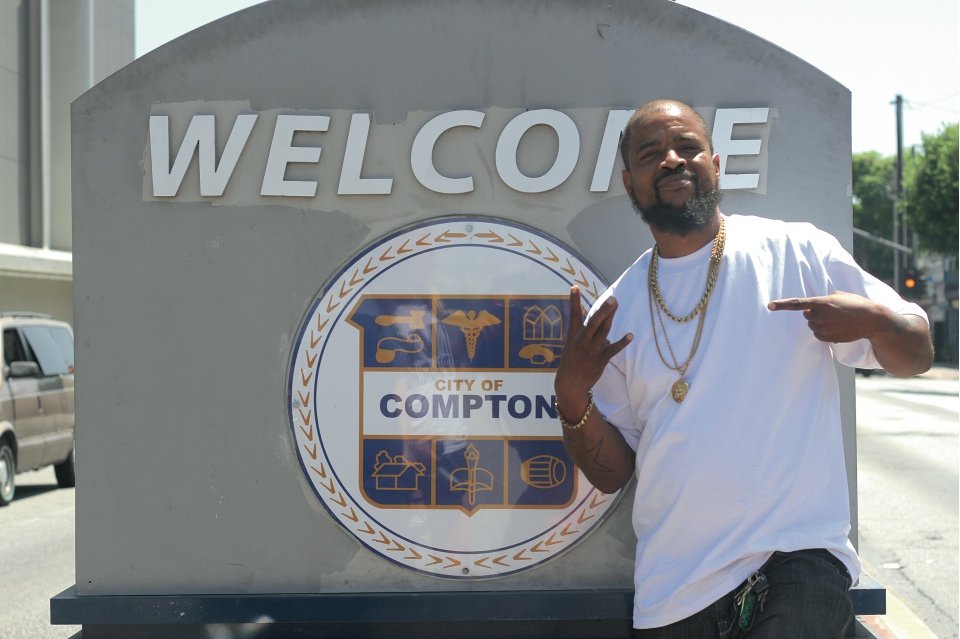 Steve, in front of the Compton sign
America’s first black president is such a hero here that a street in Crenshaw is being named “Obama Boulevard” in his honour. As well as providing black Americans with their first presidential role model, his Affordable Care Act (better known as Obamacare) gave healthcare to many residents for the first time. At the corner of Florence and Normandy, Steve tells us about a notorious incident during the 1992 LA riots, when a white truck driver was dragged from his cab and nearly beaten to death.
“The city was at war,” says Steve. “Black people were angry with racism from the police and society, but they destroyed their own damn neighbourhoods and it was just black businesses that got burned down. The city didn’t give us any help in recovering.”
Trump’s attempts to repeal Obamacare are seen by locals as an attack on poor black Americans, but his stance on immigration has more support. Many locals resent Mexicans and Koreans for buying-up black businesses after the 1992 riots, and immigration has caused a significant demographic shift: the historically black Compton now has a Hispanic majority.
San Diego
My final stop was San Diego (or at least it was supposed to be). Like the rest of Southern California, it was once part of Mexico. “Let’s head to Barrio Logan,’ says Angel Mirron, founder of food tour company Let’s Go Clandestino. “In that part of the city, it’s still Mexico!” Angel was born in San Diego and has American citizenship, but he grew up in Tijuana, Mexico. “My mother never got American citizenship,” he says, “So we lived there, and I got the bus to San Diego every day to go to school.
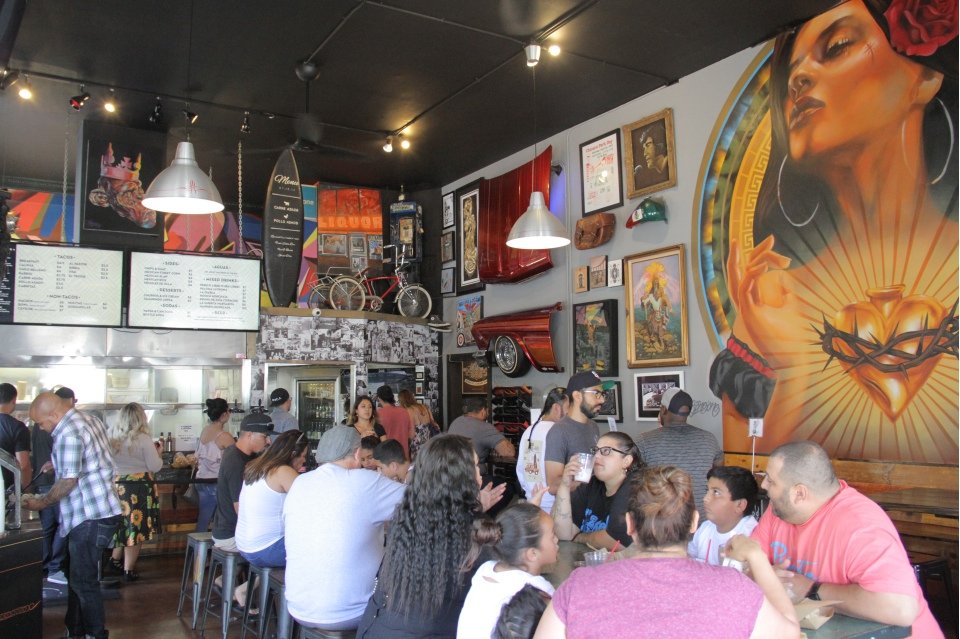 Salud, Sandiego
“I’m glad I grew up in Mexico,” he says, “because I have a different mind-set. In America, you have to ‘make it’ to have a good life. Over there, people care about family, quality of life, and food!”
Barrio Logan is the Mexican district of San Diego, and many Mexicans stay here with friends or relatives whilst looking for work. The bars and restaurants that serve them have become famous across the country.
At 11:30 in the morning, Salud! is already busy. I tucked into Birria (shredded pork in a flash-fried taco) and a michelada (a kind of Bloody Mary with beer). It’s the tastiest food I’ve eaten in America.
“That’s because so much of the produce here comes from Mexico,” says Angelo. “It’s even better over there. You wanna go?”
Tijuana
I check that I’m carrying my passport and 20 minutes later, I’m sat at the bar of Verde de Crema restaurant, across the border into Tijuana. I’m greeted by a giant Mexican flag, but none of the city’s reputation for stag dos and tequila slammers. The restaurant makes the most of fresh ingredients from Baja California (the Mexican side of the Californian peninsula), and nearby Telefonica food hall serves cuisine from across Mexico alongside beer from local breweries.
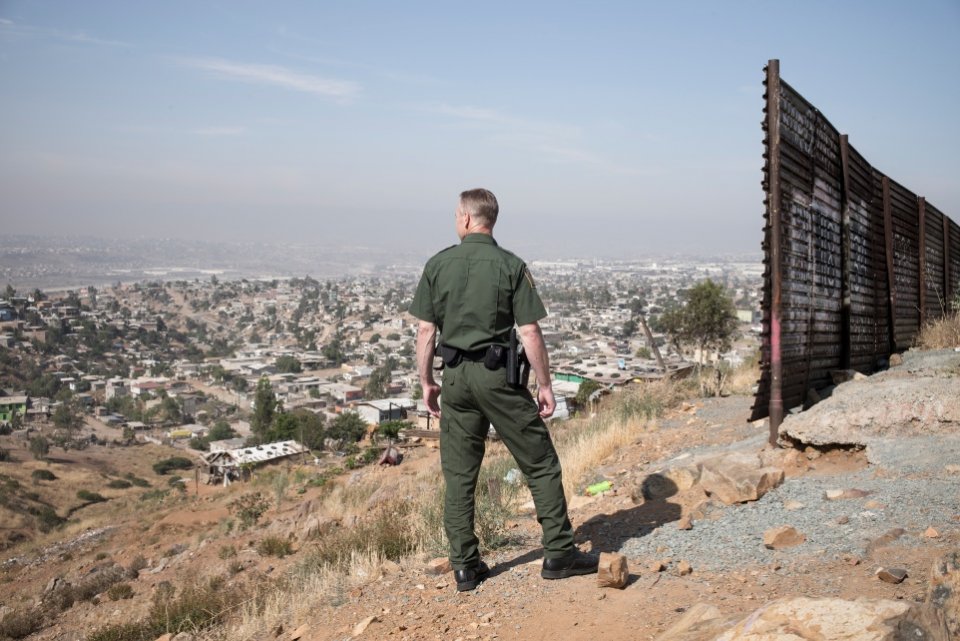 The border wall between San Diego and Tijuana
Two blocks further south I found street tacos dipped in beef consommé. It has more of a kick than the tacos in San Diego, and each meal has fewer ingredients, but every flavour is more intense. It’s like the difference between a meal in an Italian village and a meal in an Italian restaurant in London.
San Diego chefs bring elements of this cuisine back with them, creating bright, fusion food in restaurants such as Galaxy Taco. Head chef Trey Foshee came up with the idea after doing taco crawls in Tijuana on his days off.
“We’re not trying to be rock stars,” he says “Just making good food that you want to eat.”
After a lunch of guacamole, crickets (much better than you’d think), octopus and burned habanero, I kayaked across La Jolla Cove, amongst sea-lions and leopard sharks.
Cramming this much of the west coast into a single trip gives you just the faintest hint of how varied and multi-faceted this country really is. Political consensus seems laughable in the face of such diversity. But what struck me most was that where I’d expected anger, there was mostly hope, with a little resignation. There’s a limit to what Trump can dismantle (or achieve, depending on your point of view); the communities here, from the hunters of Oregon to the taco-chefs of San Diego have legacies that will outlive any administration.
California: visitcalifornia.co.uk
Oregon: traveloregon.com
Seattle: visitseattle.org
San Diego: sandiego.org
Portland: travelportland.com
Washington state: experiencewa.com
Hertz USA Road Trip Planner (hertz.co.uk). The Hertz USA Road Trip Planner allows you to browse 25 routes; giving you insider guides, downloadable maps, iconic landmarks and historical locations. Three weeks rental of a Nissan Versa (or similar) from Seattle Tacoma Airport to San Diego-Lindbergh Airport costs from £1033.