Skip to content
City PM
  • Germany
  • France
  • Europe
  • Markets
  • Business
  • Opinion
  • Germany
  • France
  • Europe
  • Markets
  • Business
  • Opinion
Wednesday 31 July 2024 5:45 am  |  Updated:  Tuesday 30 July 2024 1:16 pm

Crawling back to the EU after Brexit will only end badly for Britain

By: Paul Ormerod

Add as a preferred source on Google
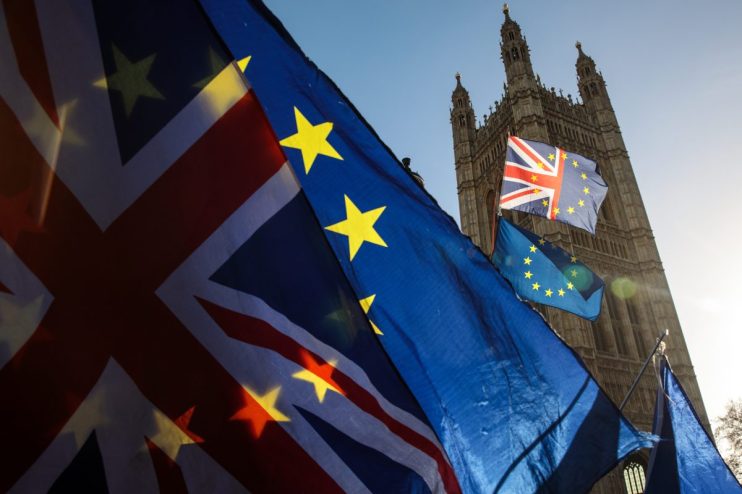
LONDON, ENGLAND - JANUARY 08: Anti-Brexit protesters demonstrate outside the Houses of Parliament in Westminster on January 08, 2019 in London, England. MPs in Parliament are to vote on Theresa May's Brexit deal next week after last month's vote was called off in the face of a major defeat. (Photo by Jack Taylor/Getty Images)
Parliament is set to be the hotbed of fiery Brexit debates again.

The new government is seeking closer ties to the EU, but Brussels will not be kind to a prodigal son, writes Paul Ormerod

Clear signals are being emitted by Keir Starmer’s government on the European Union (EU). A much closer relationship is being sought on a wide range of issues such as trade and defence.

For the time being, the Prime Minister has ruled out a formal application to rejoin the bloc. But it would not be a surprise if Labour fought the next election with this in its manifesto.

The vote to leave the EU was held at the end of the second quarter of 2016.  Since then, the economy has only grown at an annual average of one per cent.  

This is a key part of what is now the prevailing narrative, in which it is held that our economic ills are due to leaving the European trading bloc.  

Of course, the UK did not formally leave until 1 January 2021.  But once the referendum result was announced, plans were made by companies in anticipation of the UK being out of the EU.

It might be thought, according to this account, that by leaving the EU, the country excluded itself from a dynamic, rapidly growing economy.  But the data tell a different story.

In the first quarter of this year, the latest data currently available, GDP in the UK was just 8.3 per cent higher than in the second quarter of 2016.  In France the increase was 9.6 per cent, but it was only 7.7 per cent in Italy and 5.8 per cent in Germany.

Someone looking at the data from, say, Mars, entirely unaware of the bitter controversies over Brexit, would conclude that the four largest economies in Western Europe had grown at more or less the same rate since 2016.

Read more

Brexit 10 years on: Business does not want a referendum rerun, says CBI chief

CBI Chief Economist Newton-Smith addressing economic trends at a business conference podium with charts in the background

These growth rates are certainly slower than they had been previously.  But our hypothetical Martian might well conclude that their close similarity suggests a  powerful common factor, or factors, at work.  

This would be more plausible than believing that one of them, namely the UK, would have substantially outperformed the other large European economies if it had not  inflicted massive damage upon itself.  This is exactly the implication of the argument that many of our economic problems stem from Brexit.

True, the Eurozone economy as a whole was 10.5 per cent larger than in 2016, but this is due to many of the smaller economies growing somewhat faster than the larger ones.  In any event, this number is put in the shade by the 19.4 per cent growth registered by the American economy over the same period.

Regardless, it is clear that the government will try to get closer to Brussels and, as it sees it, mend fences with the EU.

There may well be some minor points where the EU will agree to the UK’s proposals without much of a fuss.

In terms of more serious negotiations, Brussels has form. The EU was certainly ruthless in the Brexit negotiations and the UK ended up with rather a poor deal.  

We might reasonably wonder why Brussels would be any less brutal in negotiations during the course of the parliament. The issue of access to UK fishing rights, for example, has already been raised.

The logic is that they have to continue to send signals which deter anyone else from even thinking about leaving. It would set a dangerous precedent if the UK could leave and then snuggle back up, cherry picking concessions as it suits us.  

But there is one set of circumstances in which we can be sure that the EU would be charm personified. This is if the UK were essentially to capitulate, to accept EU governance over a wide range of issues whilst remaining on the sidelines as a non-member. Otherwise, the government is in for a very tough set of negotiations.

Read more

Banks call for ‘political mandate’ to bolster European defence

News article image depicting a significant business meeting with diverse executives discussing strategy around a conferenc...

Share this article

  • Facebook
  • X
  • LinkedIn
  • WhatsApp
  • Email

Similarly tagged content:

Sections

  • Opinion

Categories

  • Opinion

People & Organisations

  • Brexit
  • EU
  • trade
  • UK economy
  • UK trade

Related Topics

  • Brexit
  • EU

Trending Articles

  • Two solicitors linked to Post Office scandal charged with misconduct

  • Revealed: Secret Treasury plan to tax State Pension before it is paid out

  • Clarkson’s Farm and why businesses must stop blaming the weather

  • As it happened: Stocks tumble after Apple rattles global markets; UK food exports hit by US tariffs

  • Barclays and Lloyds join banking sector plan for digital ID

More from City PM

  • Brexit 10 years on: Business does not want a referendum rerun, says CBI chief

    Business
    CBI Chief Economist Newton-Smith addressing economic trends at a business conference podium with charts in the background
  • Banks call for ‘political mandate’ to bolster European defence

    Banking
    News article image depicting a significant business meeting with diverse executives discussing strategy around a conferenc...
  • EU airport chief: ‘I don’t know how we’ll cope’ with new border system

    Transport & Infrastructure
    Drop off charges at UK airports have reached the highest level on record amid booming travel demand this summer.
  • Brexit 10 years on: Labour’s EU reset deal is ‘no growth strategy’

    Politics
    According to a new report from UK in a Changing Europe (UKICE), UK services trade has been more resilient than almost all other advanced economies.
  • Brexit ten years on: my journey from Remain to Leave

    Opinion
    UK Parliament voting on Brexit Leave decision, politicians in debate, capturing pivotal moment in Brexit negotiations
  • On this day: Brits vote in referendum that changes everything

    Opinion
    UK flag and EU flag waving side by side, symbolizing Brexit referendum discussions and future political relations.
  • Starmer weighs cut to EU student fees in bid for Brexit reset

    Politics
    Prime Minister Keir Starmer speaks at a press conference addressing future leadership rumours, wearing a navy suit and tie.
  • Gulf trade deal: Britain should learn from the success of Dubai

    Opinion
    Dubai skyline featuring iconic skyscrapers and modern architecture under a clear blue sky, showcasing the citys urban land...

City PM — European politics, business and analysis.

Europe

  • Germany
  • France
  • Europe
  • UK & Ireland

Topics

  • Business
  • Markets
  • AI
  • Technology
  • Opinion
  • Energy

More

  • Politics
  • Economics
  • Fintech
  • Legal
  • Sport
  • Life

Company

  • About City PM
  • Editorial Policy
  • Corrections
  • Contact
  • Terms of Use
  • Privacy Policy
  • Cookie Policy
© 2026 City PM · Published by CityPM Media, Bahnhofstrasse 65, 8001 Zürich, Switzerland
About · Editorial Policy · Corrections · Contact · Privacy