
Burberry’s decline shows British brands can’t trade on heritage alone

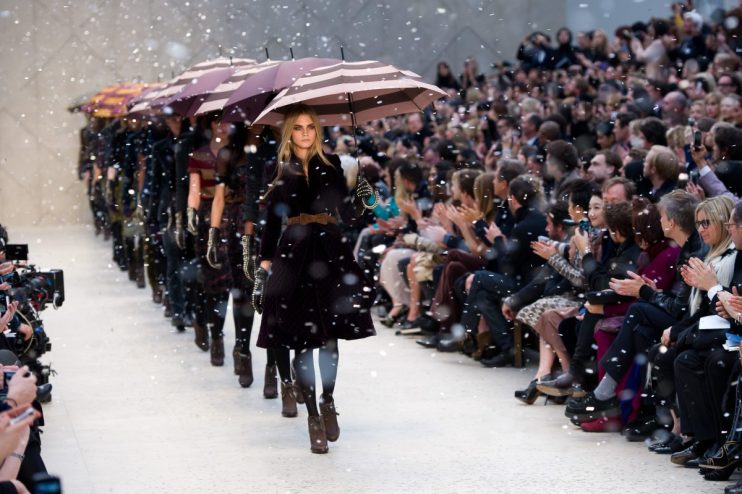
The decline of Burberry should be a cautionary tale for British luxury brands relying on heritage, writes Manfredi Ricca
When American composer George Gershwin visited his idol, Maurice Ravel, and asked whether he could study with him, Ravel famously replied, “Why would you want to be a second-rate Ravel when you can be a first-rate Gershwin?”
This tale captures the spirit of what seems to have been going on with Burberry.
The decline of Burberry
Back in the early 2010s, with Angela Ahrendts and Christopher Bailey at the helm, Burberry struck a perfect balance between three elements: the brand’s origins (the trench), its cultural relevance (a celebration of Cool Britannia) and an underserved group of target customers (younger, digital-savvy audiences).
But the past eight years have seen Burberry fight to establish itself as a fully fledged luxury house – a struggle that has seen it fail to deliver growth or profit. In 2018, the brand dropped its iconic knight pictogram, diminished the use of its check pattern and turned to less familiar categories. It has since rebranded twice – ending up as an unlikely Chanel rather than a perfect Burberry.
This brand confusion has led to a dilution of the brand’s essence and less association with luxury. Inevitably, its financials have reflected the chaos. Profits have fallen 17 per cent, and to reduce costs by 2027, the brand has announced plans to cut 1,700 jobs, nearly 20 per cent of its workforce.
To combat its decline and confused brand image, Burberry is taking steps to return to where it has been historically strong. Specifically, in classic outerwear products like trench coats and scarves – a key part of the brand’s heritage. Over the past 12 months, it has partnered with the likes of Olivia Colman and Barry Keoghan to reinforce its iconic outerwear products.
The most recent collection and campaigns seem to reflect this return to its core apparel, with an unapologetic focus on outerwear and the check asset. It’s a move that chimes with one of luxury’s unchanging principles: never forget your roots.
Remembering its roots
The founding of Burberry isn’t just the story of a brand being built; it’s the story of innovation. Noticing how heavy and uncomfortable outerwear was, a 21-year-old Thomas Burberry set up the brand in 1856 with the aim of creating a breathable fabric that would allow people to move freely. Some two decades later, he achieved his goal by inventing gabardine, a woven waterproof fabric which launched the brand’s global success.
Then, in the early 1900s, the British War Office asked Burberry to design a coat to replace its current heavy design. The result was a practical lightweight raincoat with storm pockets, buckled cuff straps and D-rings to attach military equipment – the famous trench coat was born.
Over many years, this has evolved to become a popular fashion staple and an important part of British fashion heritage. Burberry’s CEO Joshua Schulman clearly sees the trench coat as essential to the brand’s future success but also acknowledges there’s more work to be done. Finding its previous levels of cultural relevance may require more time, particularly with Britain becoming a more fragmented and less optimistic market.
A bellwether for British luxury brands
Indeed, this is the narrative for British luxury as a whole. It is a turbulent macroeconomic climate, factoring in global trading challenges, the cost of living crisis and high inflation – and the luxury industry is feeling the consequences. Harvey Nichols recently reported almost £100m in losses and the UK arm of Michael Kors is planning on lowering its prices after dwindling sales.
We now face the prospect of British-owned luxury brands, which stand for centuries of British heritage, disappearing. In 2017, Jimmy Choo was acquired by Michael Kors. Earlier this year, Kurt Geiger was acquired by Steve Madden. Ted Baker closed all of its UK shops last year. As economic uncertainty continues, British luxury brands need to assess where their assets lie, what today’s luxury shopper is looking for and how brands can thrive and adapt to be part of a revitalised industry.
Luxury British brands are renowned across the world. Steeped in history, they have stood for high-quality, impressive craftsmanship and a deep-rooted heritage that spans centuries, whether it’s the Burberry trench coat, the Land Rover offsprings or the punk aesthetic of Vivienne Westwood.
The current Burberry story shows the dilemma for luxury brands trading on their provenance and heritage. These should be proof points, demonstrating qualities that are desirable and sometimes rare – but if provenance and heritage become the promise, they end up undermining the brand’s relevance and vitality. Great luxury brands are labs, not museums.
For us to see a future where British luxury brands thrive, they need to recover the same spirit that saw them grow in the first place by spotting an unaddressed need or desire, and look bravely ahead. Their past is a proof point, not a destination. They need to find their own version of being a first-rate Gershwin, rather than a second-rate Ravel.
Manfredi Ricca is global chief strategy officer at Interbrand