
Build, Baby, Build: The private sector alone won’t fix the housing crisis

The private sector has never delivered the 300,000 homes a year the government says we need; local authorities must be part of the solution, say Gideon Salutin and Niamh O Regan
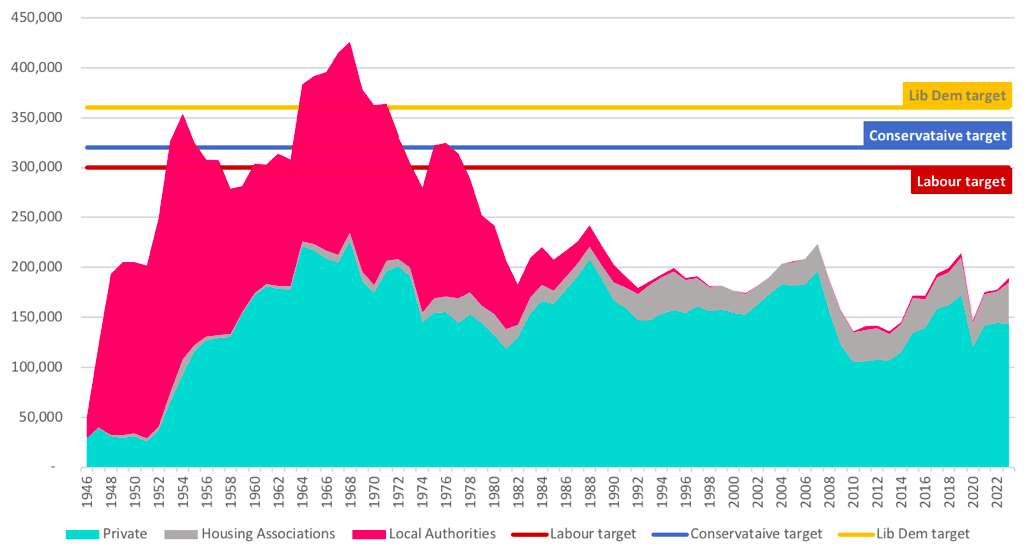
All the major parties are promising more homes at this election. Labour has promised 300,000 a year for England, while the Conservatives have pledged 320,000 a year. The Liberal Democrats committed to 380,000 a year over the whole of the UK. While the ambition is clearly high, whether it is actually feasible is a different story altogether.
Housing targets are an unusual tradition in British politics. You rarely see Biden or Trump one-upping each other based on how many millions of homes they can build, as responsibility for housing is spread across various branches of government. Yet in the UK’s centralised system these stump-speech bidding wars are commonplace. They can be traced at least as far back as 1951, when Churchill outflanked Atlee by promising to build 300,000 homes per year, seen as inconceivable at the time. Rab Butler, who would soon become chancellor, was hesitantly asked “Could we do it?”
The Tories not only hit that number but surpassed it, reaching 350,000 per year before the end of their first term. For most of the next 25 years, Westminster parties kept annual construction above 300,000 a year, with a whopping 426,000 homes in a single year in 1968.
What was their secret? Council housing. During the 1951 parliament, 74 per cent of homes were built by local authorities. Less than a quarter were made by the private sector, with the rest made by housing associations. Local authorities continued to play a deciding role throughout Britain’s housebuilding boom years from 1950 to 1980. Since then, private sector building has ranged from 100,000 to 200,000 per year, and local authority construction has been near zero. While private sector construction has fallen relative to population, the loss in local authority construction was by far the largest factor.
UK permanent dwellings completed by sector
Source: ONS
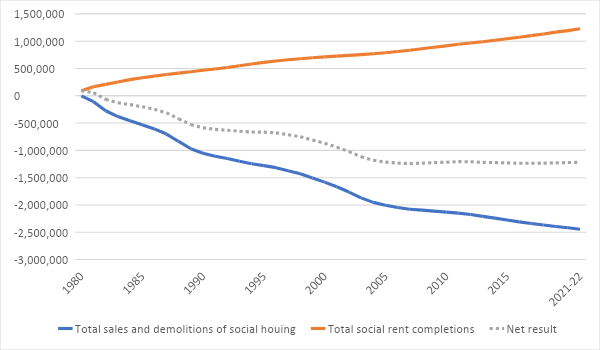
On council housing, we are going in the wrong direction. As highlighted in a recent SMF report funded by the Nuffield Foundation, stock lost through sales and demolition is not being replaced at an equivalent rate, continuously shrinking what little is available. All the while, the waiting list for social housing has grown to 1.2m households.
Cumulative sales, demolitions and completions of social housing since 1980
Source: ONS
Politicians seem to have forgotten past successes. Of the three major parties, only the Lib Dems have actually set a target for social housing construction which, if private sector building remained stable, would be sufficient to reach their target. Labour and the Tories remain committed to providing “more” social housing, but without a specific measurable pledge, instead relying on planning reform to boost their numbers. This would cut red tape for the private sector to (supposedly) unleash a wave of new homebuilding.
While planning reform is welcome, it is unlikely that it can alone meet the parties’ lofty ambitions. Even in the 1930s, when homebuilders benefited from advances in transport technology, unchecked urban sprawl, government stimulus packages, and weak investment alternatives, the private sector alone couldn’t crack 300,000. And since the Second World War, the UK’s businesses have never built more than 226,100 homes in a single year. Nevertheless, policymakers are claiming that red tape is all that restrains private sector construction.
In fact, the sector faces challenges well beyond planning bottlenecks. Inflation has increased the cost of housing materials 34 per cent since 2020. Labour shortages, meanwhile, are challenging construction trades, with the Construction Skills Network a shortfall of 250,000 by 2028. Building homes has become more expensive and takes longer.
Competition is also a problem. The market share controlled by large developers reached 60 per cent in 2015, and a House of Lords report concluded that the UK housebuilding industry now displays “all characteristics of an oligopoly” while a Housing Minister likened the sector to a ‘cartel.’ A CMA report this Spring found that “Private developers produce houses at a rate which they can be sold without needing to reduce their prices, rather than diversifying the types and numbers of homes they build to meet the needs of different communities.” The monetary principles of supply and demand inevitably create perverse incentives for builders to limit construction rather than increase it.
As a result, the private sector has never built more than 226,070 UK homes in a single year – 200,000 less than the UK’s record in a year. Last year, this number was just 144,000.
The private sector has delivered inadequate levels of housing since 1945, yet Labour and the Conservatives are continuing to pitch businesses as the key agents capable of meeting abstract targets and boosting construction. The parties do not want to admit it but the reality is that ambitious targets for housebuilding cannot be met by the private sector alone: council housing must be part of the solution.
Neither major party has a credible plan to meet housing demand. Ask Rab Butler today if government can reach its target, and you’d likely get a different answer.
Gideon Salutin is senior researcher and Niamh O Regan is researcher at the Social Market Foundation