
Brussels’ tobacco ban risks fuelling illegal immigration

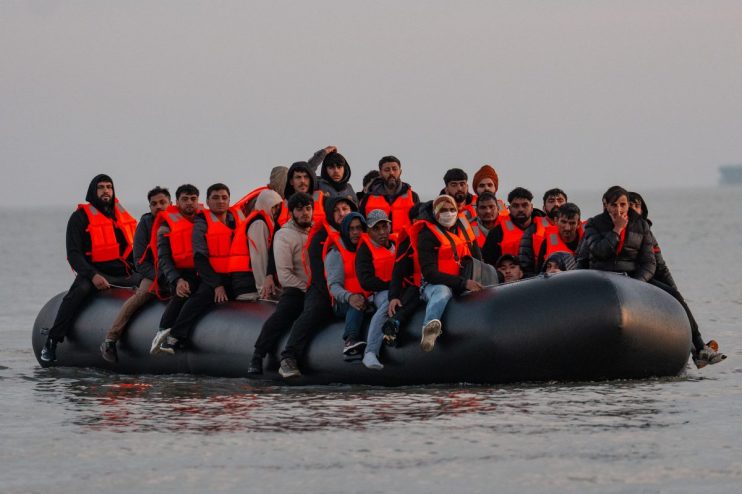
A proposed EU tobacco tax hike risks fuelling organised crime, illicit trade, and people smuggling across Europe and into the UK, says Tom Pursglove
Recent headlines suggest that up to 50,000 illegal migrants could cross the Channel this year – a figure that provokes a palpable sense of dread amongst the British public. People have had enough: of the crossings, the hotel bills, and the rank unfairness of it all. Add to that senior policing leaders persistently warning of increasingly overstretched forces and the rising threat from organised crime, and it’s clear we face a growing national challenge.
As a former home office minister, I’ve seen how these threats interact – and how they can escalate from a failure of governments to treat them as a complex interconnected ecosystem, and having not confronted the brutal facts early enough. This risks responding with one-dimensional policies that fall apart under operational pressure, and often throwing up an array of unintended consequences.
This brings me to an unlikely but important example coming up on the horizon.
According to a leaked draft, the EU is planning to raise tobacco excise levels massively across the bloc; 139 per cent on cigarettes, 258 per cent on rolling tobacco and 1,092 per cent on cigars.
The apparent goal is to recover lost tax revenue due to illicit trade, and Wopke Hoekstra, Brussels’ Tax Commissioner, is lobbying his colleagues hard to raise EU excise rates, hoping to neutralise cross-border incentives by making tobacco more expensive everywhere, not just in his native Netherlands.
This matters to the UK, and we should be worried, as this broad-brush simplistic proposal is a huge potential gift to organised criminal gangs (OCGs) across Europe, who, on illicit tobacco specifically, predominantly operate in high-excise countries, but with this proposal could expand their market to the entire European Union.
We can see elsewhere what happens when ill-thought-through tobacco excise policy creates lucrative gaps.
In Australia, high tobacco excise has triggered what the media call the “Tobacco Wars”. To put it in some context, 75 per cent of tobacconists in Victoria now sell smuggled products. Fire-bombings happen weekly for outlets that don’t play ball. People have died, the police are overstretched, and there’s no end in sight.
Perverse incentives
The perverse incentives are clear. The Australian Black Economy Taskforce estimates profits from tobacco smuggling can be four times higher than drugs, and while drug trafficking can carry life sentences, tobacco smuggling attracts a fraction of that. This creates conditions where violence thrives to protect market share.
Australia is thousands of miles from its neighbours. Europe borders Belarus, Serbia, Turkey, Albania and North Africa – all with long-established smuggling routes. If excise skyrockets, Europe could face an even greater explosion in illicit trade than Australia. Candidly, we must learn from the mistakes of past efforts in tackling emerging and growing OCG operations, including the small boats phenomena. After all, back in 2018, nobody predicted the scale of the crossings challenge we see today.
At the Home Office, I saw how deeply embedded poly-criminality has become and how easily it can take hold. The same groups that smuggle tobacco often traffic people, drugs, counterfeit goods and weapons – something both Europol and the National Crime Agency recognise.
Indeed, a major national newspaper recently described the UK’s current state as a “fake cigarette pandemic.” In Newcastle Upon Tyne alone, the Head of Trading Standards has said that when it comes to fake cigarette shops, “There were none here 10 years ago, now there’s 100.” Multiply that across the country and the scale becomes clear. That footprint is growing by the day.
The public health risks are real – dirty tobacco (think mould, asbestos dust, rat droppings) and fire hazards as a result of not using self-extinguishing paper. But worse still are the harrowing human stories: in Darlaston in the West Midlands, a police raid found four people, three Chinese men and a woman – naked, enslaved, forced to stuff tobacco pouches in a secret room, and with sexual violence all part of the operation. Heinous modern slavery is not theoretical. It is happening right now, behind shopfronts, fuelling criminal profits and furthering their corrosive reach.
A booming illicit trade in tobacco means more cash is readily available for the evil gangs and attracts even more to enter the market, exacerbating what are already acute societal harms.
And there’s the challenge. For example, a surge in criminal capital across Europe will mean new people smuggling routes, fiercer price competition, and cheaper access for people across the Middle East, Asia and Africa to reach the Channel. The French already struggle to maintain order on their northern beaches; the UK system, already at breaking point, will be totally overwhelmed: more crossings equals more migrants in hotels and more deaths en route.
So yes, European tobacco tax policy matters.
Not because the health aim is wrong – and which is something I support – but because taxation alone, without joined-up thinking around enforcement and crime deterrence, not only won’t deliver on the objective, but will give rise to other serious harms we could well do without. People will still smoke if they want to – just increased numbers will do so illegally – with the profits going straight to the people smugglers. This is the law of unintended consequences.
For too long, governments – including our own – have often treated taxation decisions in splendid isolation, ignoring how they feed into wider policy and operational ecosystems. That risk is even more heightened when cross-border dynamics are at play – ‘out of sight, out of mind’. It’s time we changed that. The EU really should think hard before naively pushing ahead with an ill-thought-out tax hike, making the same mistakes Australia have – but on a far bigger scale, and with consequences that will reach our shores.
My point is that there is a complex, multi-layered debate to be had on this issue, and we should embrace that opportunity in designing an optimal policy response fit for today’s reality. So at a time when Ministers regularly espouse their newly redesigned UK-EU relationship, this is an early test. Common sense says, and past experience shows, that we must look at these issues in the round – not as isolated Treasury balance-sheet lines, or simplistic, quick to announce and quick to deliver policies – but as complex challenges that require coordinated thinking, joined-up plans, and proper regard for cross-border dynamics; an angle which we simply cannot afford to see ignored any longer.
Tom Pursglove is former home office minister of state