
Best of travel: A psychedelic trip to San Jose Del Pacifico

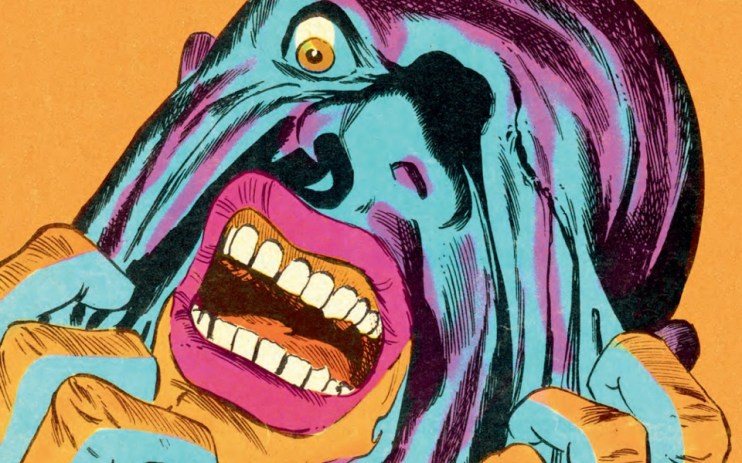
To tide us over until we’re able to travel again, we’re republishing classic travel stories from our archives. This week we revisit Alex Dymoke’s trip to San Jose Del Pacifico, where he discovered the darker side of psychedelic tourism.
•••
It’s a beautiful day in San Jose Del Pacifico, a small village high in the mountains south of Oaxaca City, southern Mexico, where I’m sitting in front of the world’s most frightening cup of tea. Opposite me is Paolo, a 19- year-old “mushroom guide” in whom I have placed an inordinate amount of trust. Are you having any? I ask. “No,” he says, and smiles. “It’s all for you.”
I lift murky liquid to my lips and sip. It’s sweet, earthy, not unpleasant. This isn’t so bad, I think, and slosh the brew down. Shortly after, the nightmare begins.
•••
San Jose del Pacifico marks the half-way point on the stunning 200-mile mountain road leading from Oaxaca City to Mexico’s Pacific south coast. A steady trickle of tourists keeps a handful of hostels and restaurants in business throughout the year. Some of these raggedy travellers come for the spectacular scenery. Others seek reprieve from the scorching heat of the coast.
The majority, however, have one thing on their mind: mushrooms. The mountains of southern Mexico occupy a special place in the history of psychedelic exploration. It was here that, in 1955, R Gordon Wasson, a vice-president of JP Morgan and amateur ethnomycologist, consumed psilocybin mushrooms in a ceremony presided over by the healer Maria Sabina.
The article Wasson subsequently wrote up for Life magazine – “Seeking the Magic Mushroom” – transformed Sabina into a reluctant icon and caught the attention of scientists including Harvard psychologist Timothy Leary.
After making his own pilgrimage to the region, Leary said: “I learned more about psychology in the five hours after taking these mushrooms than in the preceding 15 years of studying and doing research in psychology.”
Though magic mushrooms are illegal in modern Mexico, police tend to turn a blind eye in recognition of their centrality to the customs and traditions of the Zapotecs, the area’s dominant ethnic group.
When it comes to eating mushrooms, Zapotecs start young. Jucinda, owner of the village’s longest running hostel, recalls feeding them to her children.
“My first child first had mushrooms when he was five. My second when he was six. It made them happy, very happy. They sang and danced and laughed a lot. For us, it is not a drug, it is medicine,” she says. “It’s a cleansing of the body. If you have any sickness, physical or psychological, the mushroom give you the information that will allow you to heal.”
•••
After drinking three quarters of my mushroom tea, I start giggling uncontrollably. Paolo says, “It’s acting quickly on you,” and goes to fetch some water for our hike. His plan is to guide me on a walk to a special spot on the mountain where we will watch the sunset.
Despite being of Mexican descent, Paolo grew up in San Antonio, Texas, and only moved to Oaxaca aged 18 at the behest of his “nomad” mother, with whom he now lives at the hostel.
“When the mountains call, you have to answer,” she tells me. Together they offer mushroom tours to tourists passing through the hostel. While he’s gone I stagger onto the balcony and test my vision on the horizon. On the other side of the valley, pastel-coloured houses are lurid in the afternoon sun.
When Paolo returns, he looks in my mug and notices dregs at the bottom. “You haven’t finished it,” he says. I say I’m already feeling pretty weird, but okay. I down the last bit, mushroom slush and all. As we leave the restaurant, I start to feel on edge. I ask Paolo where we’re going. “Into nature,” he says. “But what kind of nature?” The idea of going into the forest with Paolo was suddenly deeply unappealing.
I craved expansiveness, a view, somewhere I could escape. “What do you mean, ‘what kind of nature?’ Nature is nature!” he says. “Relax.” Paolo keeps to the road for 100 yards, then takes a sharp left turn into the forest, and I follow.
It’s around now that the visuals really kick in. I scramble over branches as the trees above me flash purple, green, red, blue, orange. The soil, which is red and moist like unset clay, oozes revoltingly. Fallen pine needles on the forest floor look like cobwebs or nets.
“There are cobwebs everywhere,” I say. “Everything looks hairy. There’s hair everywhere.” “I know,” Paolo says. “Isn’t it amazing?” I start to panic. Once again I ask Paolo where we’re going. “To a clearing, where we’ll do some chanting,” he says. There is absolutely no way I am doing anything of the sort.
“I’m not enjoying this,” I say, “I need to go back to the cabana.” “Ok, that’s fine, whatever you want,” he says, looking concerned, which makes me feel worse.
•••
Between 1953 and 1973, the US government funded 116 studies into the effects of psychedelics. The mid-20th century was a time of revolutionary thinking about the mind. A few decades earlier, Sigmund Freud’s theory of the unconscious had popularised the idea that psychological health depends on the harmonious co-existence of our outward selves and the complex knot of desires and repressions beneath.
Many psychologists speculated that psychedelics, by acting as a bridge between our conscious selves and some other state, could help those suffering from difficult to treat conditions like alcoholism.
From 1961-1963, Harvard’s Dr Timothy Leary tested psilocybin on a group of inmates from a maximum security young offenders prison in Massachusetts. During the study, known later as the Concord prison experiment, prisoners reported having “transcendent” or “mystical” feelings, akin to religious experiences.
For prisoners treated with the drug, only 24 per cent reoffended within six months, compared to the ordinary rate of 64 per cent. Though questions have since been raised about the study’s methodology, it is one of many from around this time that posted encouraging results.
In the 1960s, over 1,000 scientific journals recorded ways in which psychedelic drugs could aid psychotherapy. Research, however, soon ground to a halt. By the late sixties the medical potential of psychedelics was overshadowed by their association with a hippy counter-culture viewed with increasing suspicion by middle America.
In 1970, President Nixon introduced the Controlled Substances Act, which banned the use of psychedelics for any purpose. For almost three decades, there wasn’t a single peer-reviewed study into the medical use of psychedelics.
•••
We scramble back to the road towards the cabana. On the way a phrase enters my mind: “Bad trip”. I’m having a bad trip. Bad trip. The concept amplifies my panic. Then the sensory distortion spreads to my hearing. Paolo tries to reassure me, but his voice sounds all sped up, like a tape on fast forward.
When I get back to my room I can’t work out how to get inside. My key is in my pocket, and I know something involving the key has to take place in order for me to gain entry, but somehow the concept of opening a door with a key eludes me.
I start to feel paranoid that my mind is gone forever. Paolo’s mum appears. “I hear you are having a bad time,” she says. She holds my hands and stares into my eyes. “You need to listen to the mushroom, it is trying to tell you something.” Right.
Every left-field thing she and Paolo says only heightens my sense of having entrusted my sanity to two deeply untrustworthy people. “I don’t care about any of that stuff,” I say, “Just tell me when this will end.” “About four hours.” I don’t know whether to be comforted by the fact that it will probably end in four hours or terrified that I have four hours of this to go. Plus, my sense of time is starting to slip away. Four hours? What is four hours? I have no sense of it, can’t grasp its significance. I decide to go for a walk.
I leave the hostel in search of a nice view. San Jose del Pacifico is one of the most beautiful places I’ve ever been, but I feel like I am in hell. The outlandish beauty of the place only contributes to its unreality and makes me feel lost, like I’m trapped in a nightmare world, universes away from friends, family, job.
I rifle through my mind for everything I’ve heard about hallucinogens and bad trips. I think of my friend who had a mushroom cocktail on his gap year in Thailand and was so traumatised he didn’t go out for six months. Another who was laid low after foolishly taking acid in a nightclub.
It occurs to me that most of the people in these horror stories are okay in the end. I’m comforted by this – for about two minutes. Then the anxiety loops back round and I begin to panic again. This is how it goes: I locate a comforting thought, hang on to it, only for reality to crumble anew.
•••
Recent years have seen a rolling back of some of the legal and bureaucratic impediments to research, ushering in what many are calling a “new psychedelic revolution”. If such a thing is underway, it is thanks in large part to one man: Roland Griffiths.
A psychiatry professor at Johns Hopkins University with impeccable scientific pedigree, Griffiths was the straight-shooter required to drag psychedelics back into the mainstream.
In a 2006 paper for the journal Psychopharmacology he wrote up several years worth of psychedelic research and invited academics to respond. Scientists from UCLA and NYU answered his call, winning FDA approval for studies into the effects of psilocybin on terminally ill cancer patients suffering from anxiety or depression.
In 2010, the New York Times reported on the UCLA study. One patient, a retired psychologist with stage four cancer named Clark Martin, said: “All of a sudden, everything familiar started evaporating. Imagine you fall off a boat out in the open ocean, and you turn around, and the boat is gone. And then the water’s gone. And then you’re gone.”
For Martin, the experience on psilocybin alleviated his fears of dying more than antidepressants and talking therapies. Six months later, he still counted it among the most meaningful experiences of his life. He is not the only participant to report a perspective-altering, life-affirming experience.
“Under the influences of hallucinogens individuals transcend their primary identification with their bodies,” said Dr Charles Gob, one of the scientists leading the study. “They experience ego-free states before the time of their actual physical demise, and return with a new perspective and profound acceptance of the life constant: change.”
•••
I walk north up the mountain. A few times I veer into the road and cars beep. I say out loud to myself “You’re not safe. You need to go back.” I find it comforting to speak out loud, the sound of coherent phrases a welcome counterpoint to the insanity unfolding in my mind.
When I arrive back at the cabana Paolo’s mum is still there. Noticing my agitated state, she says: “If you want we can land you now.” Land me? “All you need to do is eat a banana.”
LIAR! A banana won’t do anything! Your son just fed me a serious dose of hallucinogens and you’re saying a banana will ‘land me’, I scream internally.
Desperate, I trudge up the stairs, which are like treacle beneath my feet, to where the bananas are. I realise I don’t know where I am, when I arrived, how I’d got there.
I need to be back in London for Christmas and I’m not going to make it. I’ve lost my mind. I try to say “San Jose del Pacifico” out loud but can’t make it to Pacifico. I feel completely insane, overcome with grief for my mind which I am convinced is irretrievably broken.
I eat the banana. Nothing. “I had the banana and nothing happened,” I say to Paolo’s mum. She said, “How many did you have?” One, obviously. Nobody eats two bananas. On her advice I eat another. Still tripping, I decide to go back to my room and ride it out in bed.
Everything looks alien. Things I remember being on the left are on the right. I try listening to music, but the sound melts in my ears. I go for another walk and get lost. I ask for directions to the main road, which I’m already standing on. I will be in hospital forever, I think, stuck in an endless trip. Family members will visit and fold their arms and shake their heads and wonder what could have been.
Then, at around a few hours later, the trip wears off. The sun is setting and I feel euphoric. Coherent thoughts begin to stream back into my mind and the world takes a familiar shape around me. I remembered where I am: “San Jose Del Pacifico”. I can even say it.
In recent studies into psilocybin, bad trips barely get a mention. Some new evangelists have even suggested they are a myth. They are not a myth. Since the experience I have read countless psilocybin testimonies, the vast majority positive.
I was struck by how similar even the very best trips sounded to my own terrifying experience: the depersonalisation, the destruction of ego, the feeling of being outside of time. And though what I experienced was undoubtedly the worst six hours of my life, I see how it could have been a euphoric experience given slight changes in context.
There’s a movement among psychedelic advocates to rename bad trips “difficult” or “challenging” in recognition of the fact that negative trips are often the most meaningful for those who endure them. I’m yet to work out what mine meant. I did, however, learn one very important thing: I am never taking hallucinogens again.