
Bank of England warns of ‘severe risks’ to market stability and financial crisis debt levels
The Bank of England’s emergency £65bn bond buying scheme – that its chief Andrew Bailey last night confirmed will end on Friday – has been fighting “severe risks” to UK financial stability, the central bank said today.
Turmoil in UK gilt markets since the government’s mini budget threatened to trigger “an excessive and sudden tightening of financing conditions for the UK real economy,” the Bank warned in its financial policy committee report.
The Bank’s comments are the latest in a string of warnings illustrating the scale of volatility it is trying to stamp out.
On both Monday and Tuesday, it ramped up its £65bn time-limited bond buying programme and issued similar alerts to today.
Last night, Bailey said liability driven investment (LDI) funds, which pensions use to meet obligations to pensioners, had “three days” to sort themselves out.
Yield on 30-year UK gilt
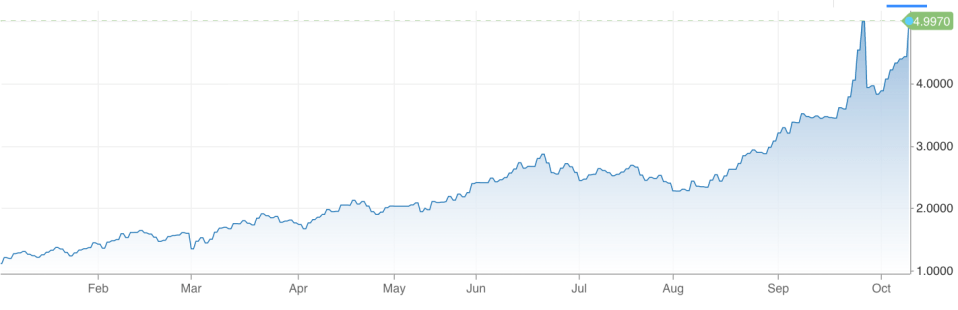
Yields on UK 30-year gilts surged to over five per cent this morning, while the pound strengthened against the US dollar.
The Financial Times reported this morning the Bank had told market participants the emergency support could be extended beyond Friday’s deadline.
Pension industry bigwigs yesterday called for the package to be extended past 31 October.
However, the Bank rebuffed the FT’s report, saying today Bailey has been “absolutely clear in contact with the banks at senior levels” that the package will finish on Friday.
After prime minister Liz Truss and chancellor Kwasi Kwarteng’s mini budget last month, a sudden bond market sell off cut the value of LDI funds’ investments, triggering a wave of lenders to demand they stump up cash immediately to cover losses.
This sparked yet more bond selling, sending yields on long dated government debt to the highest level in over 20 years.
Yields and prices move inversely.
Speaking to the BBC’s Today programme this morning, business secretary Jacob Rees-Mogg argued chaos in UK financial markets was primarily the result of the US Federal Reserve hiking interest rates quicker than the Bank.
However, Huw Pill, the Bank’s chief economist, rebuffed those claims today.
“The volatile market dynamics that followed the announcement of the growth plan [on 23 September] underline the need to bolster the credibility of the wider institutional framework, in line with my earlier remarks,” he said in a speech in Glasgow.
Analysts have argued the government’s decision to launch £43bn of tax cuts and step up borrowing to pay for the energy price cap without an independent assessment from the Office for Budget Responsibility (OBR) sparked the market jitters.
The Institute for Fiscal Studies estimates borrowing will hit £194bn this year and stay above £100bn for each of the next four years.
The OBR is set to release new economic and debt forecasts and Kwarteng will provide more detail on shoring up the public finances on 31 October.
Higher rates in the UK gilt market have pushed swap rates – which are used by lenders to price mortgages – higher. This has raised average mortgage rates to over six per cent.
As a result, the proportion of households at risk of defaulting on their home loans could “increase by end-2023 to around the peak levels reached ahead of the global financial crisis,” the Bank warned.
The 2008 global financial crisis was primarily driven by banks signing off home loans to people who struggled to pay debts amid an economic slowdown and a reduction in house prices.
Homeowners fell into negative equity, meaning the value of their house was not enough to cover their mortgage debt. This either resulted in people defaulting or banks repossessing homes.
Economists have warned UK property prices may fall as much as 20 per cent due to higher mortgage rates sucking demand out of the market. If that were to happen, negative equity and default rates would likely rise.