Skip to content
City PM
  • Germany
  • France
  • Europe
  • Markets
  • Business
  • Opinion
  • Germany
  • France
  • Europe
  • Markets
  • Business
  • Opinion
Tuesday 04 February 2025 6:00 am  |  Updated:  Wednesday 05 February 2025 1:23 pm

Bank of England: Monetarists warn of challenging outlook before rate call

By: Chris Dorrell

Add as a preferred source on Google
Governor Andrew Bailey has launched a defence of the Federal Reserve's independence.
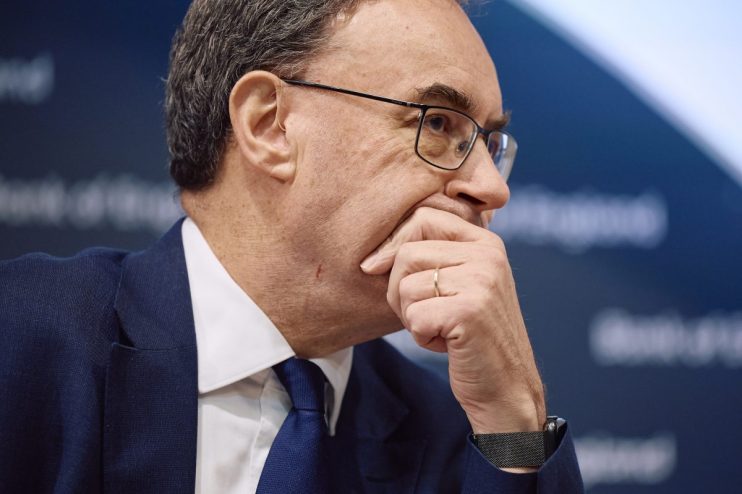
Andrew Bailey has said an interest rate cut if 'off the table'

The Bank of England faces a “very challenging” outlook as it navigates the impact of its own management of the money supply, leading monetarist economists have warned.

The Monetary Policy Committee (MPC) will meet on Thursday, and markets expect rate-setters to back a 25 basis point reduction in the Bank Rate.

But monetarist economists, a school of thought adopted by Margaret Thatcher, argued this may be too little too late given the current weakness of the UK economy.

“The reality is simple, current monetary policy is too tight, and it’s holding the economy back,” Damian Pudner, an independent economist and former director of the Institute of International Monetary Research said.

Monetarism is a school of thought which suggests that the primary macroeconomic objective for policymakers is to control the growth of the money supply.

The money supply captures the sum total of all the currency and liquid assets in a country’s economy. It is linked to GDP and inflation, although the exact nature of the relationship is heavily contested.

Many monetarists argued that the surge in inflation in 2021 was driven by the rapid growth in the broad money supply, which hit 15.4 per cent in the year to February 2021.

But having been too slow to hike interest rates post-pandemic, many monetarists were vocal in calling for more aggressive monetary easing in 2023 and 2024 when growth in the money supply collapsed.

Andrew Lilico, executive director of Europe Economics, argued that the economy was currently “seeing the fruit” of the Bank of England’s reticence on rates.

He noted that the annual growth rate of the money supply in September 2023 was -4 per cent, the fastest rate of contraction since the early 1920s.

Read more

Bank of England should hold interest rates, City PM Shadow MPC says

Bailey Boe in professional attire speaking at a business conference with a presentation screen in the background.

“Everyone is blaming anything other than the Bank for it”

Lillico noted that the lag from the money supply to nominal GDP is around 18 months, meaning nominal GDP growth is likely to be very weak until March 2025.

“That was a huge and unprecedented drop. Nothing like it had been seen since equivalent records began. Such a large drop would be likely to weigh very heavily upon nominal GDP,” he said.

Nominal GDP calculates the value of an economy without making adjustments for inflation.

Lilico suggested that the UK economy’s weak performance in recent months was likely a result of the “astonishing” collapse in the money supply.

“Not for the first time everyone is blaming anything other than the Bank of England for it,” he said. “This time Rachel Reeves seems to have drawn the short straw.”

The money supply has recovered since its nadir and the most recent figures showed that the annual growth rate in broad money was 3.1 per cent in December, suggesting growth will pick up.

However, broad money growth remains below the 4-5 per cent level which is consistent with annual inflation and GDP growth of 2 per cent.

Pudner said the figures were sending a “clear warning of a weak and fragile economy…Demand is drying up, credit conditions are too restrictive, and recession risks are growing by the day.”

Bank officials no longer put much weight on monetary aggregates, reflecting scepticism about the relationship between the money supply and other macroeconomic statistics.

But Mervyn King – a former Bank of England Governor – said last year that it was “foolish” for central banks to have relied on forecasting models that ignored the role of money.

Read more

Bank of England chief economist ‘not trying to be a troublemaker’ on rates split

Chief economist Huw Pill said "consistency" was key to the Bank of England's quantitative tightening programme (Photo by: Graeme Sloan/Bloomberg via Getty Images)

Share this article

  • Facebook
  • X
  • LinkedIn
  • WhatsApp
  • Email

Similarly tagged content:

Sections

  • News

Categories

  • Economics

People & Organisations

  • Andrew Bailey
  • Bank of England
  • monetarism
  • money supply
  • UK inflation
  • UK Interest Rates

Trending Articles

  • Why brands can fail miserably at sponsoring Wimbledon

  • Harry Styles at Wembley Stadium review: running through the grief

  • Ryanair warns of ‘passport queue chaos’ with new EU border system

  • World Cup boost fails to land UK services sector on front foot

  • UK fintech Starling to axe 130 roles in AI-powered simplification drive

More from City PM

  • Bank of England should hold interest rates, City PM Shadow MPC says

    Economics
    Bailey Boe in professional attire speaking at a business conference with a presentation screen in the background.
  • Bank of England chief economist ‘not trying to be a troublemaker’ on rates split

    Economics
    Chief economist Huw Pill said "consistency" was key to the Bank of England's quantitative tightening programme (Photo by: Graeme Sloan/Bloomberg via Getty Images)
  • Borrowing costs fall as interest rate hike fears ease

    Economics
    Keanu Reeves seen casually dressed during a public appearance in a local pub, engaging with fans and enjoying a relaxed at...
  • Inflation expectations at record high in interest rates signal

    Economics
    Bank of England building on Threadneedle Street, London, showcasing its historic architecture and financial significance
  • Inflation stays below three per cent despite price warning

    Economics
    The Bank of England is expected to hold interest rates at four per cent due to stubbornly high inflation.
  • Bank of England to ‘tolerate slow return’ to inflation target as interest rates held

    Economics
    Bank of England Governor Andrew Bailey said cited several indicators that the labour market was softening.
  • What today’s central bankers can learn from the late Alan Greenspan

    Opinion
    Alan Greenspan speaking at a financial conference, emphasizing economic trends and monetary policy insights in a formal se...
  • Job vacancies fall again in unemployment risk 

    Economics
    People waiting outside a job centre, highlighting unemployment issues and job search challenges in the current economy.

City PM — European politics, business and analysis.

Europe

  • Germany
  • France
  • Europe
  • UK & Ireland

Topics

  • Business
  • Markets
  • AI
  • Technology
  • Opinion
  • Energy

More

  • Politics
  • Economics
  • Fintech
  • Legal
  • Sport
  • Life

Company

  • About City PM
  • Editorial Policy
  • Corrections
  • Contact
  • Terms of Use
  • Privacy Policy
  • Cookie Policy
© 2026 City PM · Published by CityPM Media, Bahnhofstrasse 65, 8001 Zürich, Switzerland
About · Editorial Policy · Corrections · Contact · Privacy