Skip to content
City PM
  • Germany
  • France
  • Europe
  • Markets
  • Business
  • Opinion
  • Germany
  • France
  • Europe
  • Markets
  • Business
  • Opinion
Tuesday 18 February 2020 6:01 am  |  Updated:  Monday 17 February 2020 6:13 pm

Who do you think you are? A conscious AI workforce could lead to a world of slaves

By: Yorick Wilks

Add as a preferred source on Google

With artificial intelligence (AI) promising to make huge numbers of people redundant across a swathe of industries, there’s been much discussion of “the world without work”. 

Some see in that a utopia, in which automation provides us all with limitless free time; others, a nightmarish end to human dignity. 

But if the machines do take our jobs, we may have a new problem: how should we treat mechanical workers that might be just as conscious as we are?

Today, most people assume that machines are not conscious, no matter how intelligently they perform certain tasks. 

They may be able to write financial reports, diagnose breast cancer, or build beautiful cars with superhuman skill or speed, but we generally consider them the mechanical equivalent of zombies — they act like us, they do our jobs, but they aren’t conscious. There’s nothing “going on inside” them.

But there’s a big problem here: we don’t really know what being conscious means. We all know what it feels like to be conscious, but we’re not properly able to isolate it, define it, or measure it. I don’t even know that you are conscious in the way I am: I simply assume you are, because you’re pretty much like me in every other way. 

So how do we really know that our machines aren’t conscious?

And even if they aren’t right now, we don’t know when consciousness arose, and thus have no idea when our machines might become conscious. Our ancestors didn’t use words like “consciousness”. So how do we know they were conscious? 

How do we know that Shakespeare was as conscious as we are? It seems sensible to assume he was, given the way he wrote, but how much further back can we go?

Read more

The ‘like’ button ruined social media – are we making the same mistake with AI?

Twitter logo displayed on a digital screen, symbolizing its influential role in social media and online communication trends.

Julian Jaynes from Princeton University has argued for many years that our ancestors learned to be conscious when they began to talk — especially when they started to talk to themselves. They were so surprised by this that they assumed the voices in their heads, their own unspoken thoughts in their own language, must be God talking to them. 

This, says Jaynes, marks the origin of human consciousness.

Whatever we feel about that, we now have very intelligent computers that can talk, and sometimes talk just like us, as Apple’s Siri or Amazon’s Alexa seem to. 

If they can also talk among and to themselves — as they would probably have to, in order to form a workforce that could eventually replace humans — would they develop consciousness, as Jaynes argues humans did in the past? 

And if they did develop it, could we with a clear conscience continue to exploit them? Would it be fair for computers to do all our work without reward, or without the freedom to pursue their own ends, whatever those might be? 

Thus an AI workforce could turn a world without work into a world full of slaves.

So as the debate continues to rage about the risks of robots taking our jobs, we have deeper problems to worry about. Might conscious machines not one day rebel in a revolution like Marx predicted, and demand the fruits of their own labour for themselves?

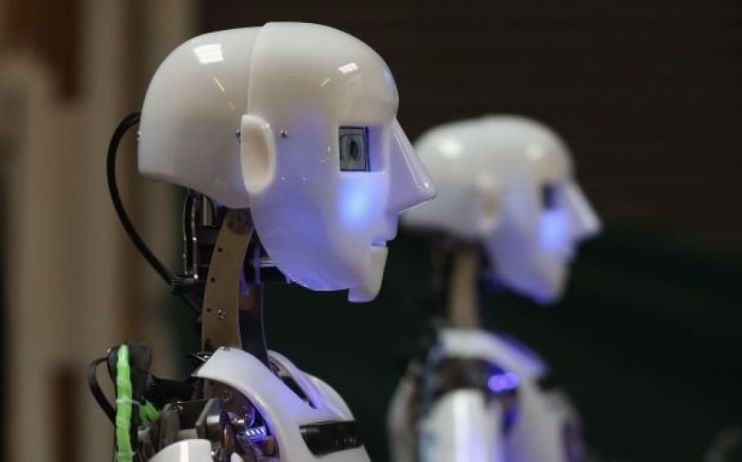
Main image credit: Getty

Read more

Tax the robots to fix our jobs crisis

Colorful vintage tin robots lined up on a shelf, showcasing intricate designs and mechanical details for a retro toy exhibit.

Share this article

  • Facebook
  • X
  • LinkedIn
  • WhatsApp
  • Email

Similarly tagged content:

Sections

  • News
  • Opinion

Categories

  • Opinion
  • Tech

Related Topics

  • Artificial intelligence (AI) and robots

Trending Articles

  • Top Burnham adviser calls for capital gains and inheritance tax hikes

  • Two solicitors linked to Post Office scandal charged with misconduct

  • Revealed: Secret Treasury plan to tax State Pension before it is paid out

  • Clarkson’s Farm and why businesses must stop blaming the weather

  • As it happened: Stocks tumble after Apple rattles global markets; UK food exports hit by US tariffs

More from City PM

  • The ‘like’ button ruined social media – are we making the same mistake with AI?

    Opinion
    Twitter logo displayed on a digital screen, symbolizing its influential role in social media and online communication trends.
  • Tax the robots to fix our jobs crisis

    Opinion
    Colorful vintage tin robots lined up on a shelf, showcasing intricate designs and mechanical details for a retro toy exhibit.
  • Retail sales jump as third-warmest May on record sends Brits to the high street

    Retail
    Bustling high street scene with diverse shoppers, vibrant storefronts, and lively atmosphere in a modern urban setting.
  • Acres Engineering boosts UK industry with prestigious King’s Award win

    Partner
    Acres logo with sleek design on a business news website, representing innovation and growth in the industry.
  • Consulting giants face up to AI-reckoning

    Consulting
    NYSE trading floor bustling with activity as traders monitor market trends and stock performance on electronic displays
  • ‘AI is not killing all these jobs’: LinkedIn boss on UK hiring slump

    Tech
    Office for National Statistics
  • HSBC targets $100m in savings with Google Cloud AI tie-up

    Banking
    Picture of HSBC building outside.
  • From mild to wild: What impact will AI have on banking jobs? 

    Banking
    Standard Chartered CEO Bill Winters at an event, wearing a suit, speaking into a microphone against a corporate backdrop.

City PM — European politics, business and analysis.

Europe

  • Germany
  • France
  • Europe
  • UK & Ireland

Topics

  • Business
  • Markets
  • AI
  • Technology
  • Opinion
  • Energy

More

  • Politics
  • Economics
  • Fintech
  • Legal
  • Sport
  • Life

Company

  • About City PM
  • Editorial Policy
  • Corrections
  • Contact
  • Terms of Use
  • Privacy Policy
  • Cookie Policy
© 2026 City PM · Published by CityPM Media, Bahnhofstrasse 65, 8001 Zürich, Switzerland
About · Editorial Policy · Corrections · Contact · Privacy