
Against the Olympics: Why we should stop worshipping elite sport

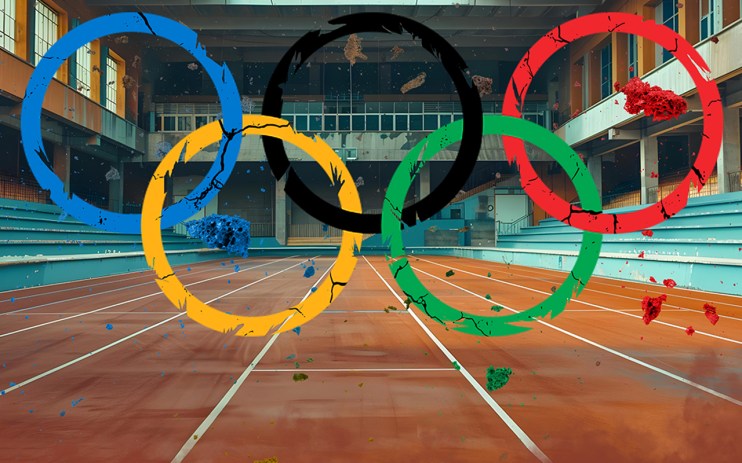
Expensive, disruptive and just plain annoying, it’s time to stop hero-worshipping the Olympics, writes Anna Moloney
Finally this month the Euros ended and I breathed a sigh of relief that I, a loud and proud hater of sport and fun, would no longer have my quiet evenings disrupted by the cheers of sporting enthusiasts. But alas, I barely had time to rub my hands together evilly with glee and the Olympics had arrived.
Taking place this year in Paris, the world on Friday night was presented with a glittering display of brawn and vigour, all floating down the (newly-sanitised) Seine in a patriotique blaze. And who could object?
Me, I’m afraid. So let’s debunk some myths.
1. Athletes are heroes
Myth number one: Olympians are heroes, representing humanity at its ultimate best not just physically but mentally, and deserve due veneration. I’m afraid not.
Citrius, altius, fortius – communiter (faster, higher, stronger – together) is the official Olympic motto, an endorsement of physical excellence, and community – though the latter, tacked onto the end of the slogan in 2021 to recognise “the unifying power of sport”, is blatantly the afterthought. Peak physical performance, all the way from the Games’s ancient roots, is what the Olympics are designed to celebrate.
Absolutely fine, if that’s interesting to you. The problem is that we don’t treat Olympians merely as that – people who are good at throwing or running or playing ping pong – but instead as near-godlike figures to be worshipped, exhibiting not just physical excellence, but mental sublimity too.
Equating athleticism with virtue goes back to the ancient Greeks, for whom the ultimate purpose of both athletic competition and philosophical study was ‘aretê’ (translated as ‘virtue’ in the context of moral philosophy and ‘excellence’ in the context of athletics). In other words, to be an athlete was to be good.
A little absurd in a modern and secular context, no? And indeed, research out earlier this year went as far as to suggest the opposite, with a study by scientists from Nottingham Trent University showing that “malevolent” traits were actually highly important in elite sports, with qualities such as being self-centred, ruthless and manipulative linked to athletic success. Such findings will come as little surprise to anyone who’s ever had the misfortune of knowing someone who’s training for a marathon/Tough Mudder/or other midlife crisis athletic event, the likes of which tend to empower participants to put theirs (and their whole family’s) life on hold for the preceding half-year of training, all in the noble pursuit of cultivating their own body. Not to mention the injuries, which strangely come thick and fast during such “health” quests.
Being the fastest may be worthy of classroom clout when you’re 10 years old, but let’s give it up as adults.
2. Sport rewards hard work
But fine, maybe athletes are selfish but they do work hard, and this is what the Olympics, a true meritocracy, reward. Wrong again.
Sure, Olympians demonstrate admirable qualities (resilience, perseverance, discipline) but we are lying to ourselves if we think this is all that contributes to athletic success, with factors independent of individual righteousness – chiefly money and genetics – clearly extremely significant.
Let’s start with genetics. Distance running, for example, has long been dominated not just by Kenyans, but specifically runners from the Kalenjin tribe, whose unique physical attributes (thin ankles and calves) are thought to have contributed to their disproportionate success. Meanwhile, a study out this week highlighted how having long, curly hair could be enough to lose an athlete a gold medal, with the increased drag enough to cut 10 centimetres off a jump distance and up to 0.07 seconds off a 100-metre sprint. The scientists suggested the introduction of hair caps and the adoption of more aerodynamic hairstyles could help “level the playing field” at the Games.
News of the launch of a doping-friendly Olympics equivalent (the ‘Enhanced Games’), which intends to go ahead next year and will allow athletes to use performance-enhancing drugs, has been met with moral outrage from the sporting world. The International Olympics Committee itself said such an event would “destroy any concept of fair play and fair competition in sport” and was “completely at odds with the idea and values of the Olympic Games”. But is it really? Or are the Enhanced Games not just the Olympic ideals – faster, higher, stronger – taken to their inevitable extreme?
The makers of the Enhanced Games, citing a World Anti-Doping Agency survey from 2011 in which 44 per cent of world-class athletes admitted to using banned substances, also argue that their games would be more honest than the Olympics. At least their athletes will admit to doping. I myself have no more interest in watching the Enhanced Games than I do the Olympics, but I do find this approach more sincere. After all, what’s the real difference between being the fastest thanks to scientific intervention versus a combination of your genetic inheritance and your haircut?
Not to mention that Olympic success is more linked to an athlete’s home country’s GDP than their inspiring journeys of endurance, with rich countries able to invest more in coaching and infrastructure. According to the Economist, more than half of the variation in Olympic medals between countries between 1960 and 2021 was linked to GDP, hence also why the US has dominated, winning 11 per cent of all summer medals between 2000 and 2021. So much for a meritocracy.
3. It’s such a joy to host the Olympics!
But, but, but – the enthusiasts cry – the Olympics are more than just sports, bringing economic prosperity, regeneration and that elusive “soft power” to whatever country is lucky enough to host it.
False! An economic boost is no guarantee from hosting the Olympics. Out of the 11 Games held since 2000, the costs of which have ranged from $2.5bn to $21.9bn, only five made any money. Of the remaining six, another five ended in losses (the largest being Athens in 2004, which made a $14.5bn loss) and one (London 2012) just broke even. For this year’s games, Paris has made an admirable effort to keep the costs down (though the €1.4bn used to clean the Seine is not included in its official costs) and has chosen not to build a new stadium, but even so the expected tourism benefits don’t look set to materialise. Air France-KLM has reported a drop in traffic as travellers choose to avoid Paris due to the Olympics, while cafes and restaurants have said an exodus of locals along with the city’s rigorous security (including QR checkpoints to access the city centre) saw their trade significantly down last week. Hotel occupancy has also been lower than expected, driving many to slash their rates in the run-up to the Games.

Anti-Olympic movements based on the darker effects of the Games have started growing in recent years. NOlympicsLA is currently working to stop the Olympics going ahead in Los Angeles in 2028, arguing the bid was rushed through against the interest of locals who are already in the midst of a housing crisis and citing the legacy of gentrification and displacement left by many modern Olympic Games. The building of a controversial judging tower in Tahiti (part of French Polynesia where this year’s surfing event is being held) despite the opposition of locals over fears it could irreparably damage the coral reef, is just one example of the scars the Olympics can leave. Likewise, the decision to allow the Games to go ahead in Tokyo in 2021, despite the fact that more than 80 per cent of Japanese people opposed hosting the event amid the pandemic, showed how the Olympics were even allowed to come above public health.
Equally, promises of regeneration are often overstated. For poorer countries in particular, who can’t afford to sustain Olympic infrastructure once the buzz of the event has died down, the Games have left them poorer and locals displaced. In Rio and Athens, stadiums have been left abandoned and crumbling, while in Beijing a “mascot graveyard”, in which giant figurines lie dilapidated (and some impaled) among a woodland behind a shopping centre, forms a fitting image of what the reality of an Olympic legacy can be.
In London, the effects of Stratford’s regeneration, accelerated by the 2012 Games, have been mixed. The Games have seen the area transformed, but some residents have reported feeling let down by the project, which has failed to live up to its promise to support locals. Sebastian Coe pledged the project would bring 30,000-40,000 new homes to the area, but 12 years on only 13,000 have been delivered, and just 11 per cent of these are genuinely affordable to people on average local incomes. A former member of the London Legacy Development Corporation, the body tasked with regenerating the area, told The Guardian that while there were “some pockets of brilliance… overall the project hasn’t improved people’s life chances in the area. We have made a new community and plonked it down on the Olympic park, creating an enormous divide.”
4. The ‘more sport’ argument
But at least we’re all doing more sport now, right? Wrong. Studies have shown that the promised “trickle-down” effects of elite sports are largely a myth. After the London Olympics, only 2.5 per cent of people reported doing more exercise due to the Games, while 8.5 per cent actually reported doing less. Perhaps all it persuaded people to do was switch on the TV and get comfy on the sofa? Allocating funds to local sport, rather than elite competitive games, would likely be more effective in making ordinary people more active.
So is it time to ditch the Olympics? I won’t be so rash. But I would urge us all to at least see through the hero worship and appreciate the event for what it is: ultimately, the world’s most overblown sports day.